Safe Distance From Transmission Antenna…

Status
Not open for further replies.

BMDaug

I am licensed…
Joined
Jan 18, 2022
Messages
1,140
Reaction score
548
Location
Central Colorado, USA
Hey everyone, I just built a man portable setup using a Harris XG-100M and a compactenna lmr-i. My question is, how much power is it safe to use?

*Regardless of radio and antenna make and model, I hope the spirit of this post is more in line with amateur radio than a “follow the manual” commercial install. My apologies if I’m out of line here. Please move this to a different sub forum if necessary.

Anyway, the radio will do 50W vhf and uhf. I’m pretty sure that’s not at all safe with the antenna less than a foot from my head. Harris says that at full power, “in a controlled environment” (this basically means an environment where there are no bystanders unaware of the transmission), safe distance is ~30” for vhf and uhf and ~8” for 7/800 mhz.

Most military man portables do around 20W (I think). Is 20W safe at that distance? It’s easy to switch between ”high” and “low” power on the go, but I need to define what these mean. High and low can be defined for each band via the programming software.

Anyone care to offer their opinion on what is a safe while wearing the pack?

Thanks,
Brian
 

alcahuete

Member
Premium Subscriber
Joined
Jul 24, 2015
Messages
2,855
Reaction score
2,753
Location
Southern California
Without calculating the actual RF Exposure, my guess would be around 1.5' or so at 20W VHF. 30" or so sounds about right for VHF at 50W.
 

prcguy

Member
Joined
Jun 30, 2006
Messages
17,994
Reaction score
13,622
Location
So Cal - Richardson, TX - Tewksbury, MA
I have various RF measuring probes for OSHA compliance, etc, and a 5 watt VHF hand held and a 4 watt UHF hand held, both with 6" long antennas reach the maximum allowed level of 5mw/cm2 for informed users at a distance around 3 to 4 inches. You would have to measure your setup with specific antenna to see what the safe level is.
 

BMDaug

I am licensed…
Joined
Jan 18, 2022
Messages
1,140
Reaction score
548
Location
Central Colorado, USA
I’d love to get a short, sprung mast, or a gooseneck, but I can’t find one! The antenna is nmo mount and I use a throughhole so239 style nmo mount/connector. What I’m trying to find is a semirigid extension with so239 connectors on both ends. I’m considering making one with a 12” spring from the hardware shop. I have a design that will work, but how will that affect swr? Does anyone have a source for such a device?

Thanks,
Brian
 

RFI-EMI-GUY

Member
Joined
Dec 22, 2013
Messages
7,951
Reaction score
5,187
I’d love to get a short, sprung mast, or a gooseneck, but I can’t find one! The antenna is nmo mount and I use a throughhole so239 style nmo mount/connector. What I’m trying to find is a semirigid extension with so239 connectors on both ends. I’m considering making one with a 12” spring from the hardware shop. I have a design that will work, but how will that affect swr? Does anyone have a source for such a device?

Thanks,
Brian

Keep it simpler the better. Also SO239's wont work well above VHF high band. You will need a multiband antenna with some sort of counterpoise large enough for VHF band. Maybe a Larsen or pulse "tri band" NMO mount with the mount brazed or soldered to a 20 inch brass pipe nested with a PVC or fiberglass tube high above head level. Put some ferrite chokes on the feedline where it leaves the brass sleeve. Keep power less that 20 watts. You might want to go to the ARRL site and look up the calculator to determine safe MPE distances at the frequency and power levels you are running.

Are you going to operate VHF low? Maybe a QRP amplifier and seperate tuneable manual screwdriver whip for that band.
 

BMDaug

I am licensed…
Joined
Jan 18, 2022
Messages
1,140
Reaction score
548
Location
Central Colorado, USA
Keep it simpler the better. Also SO239's wont work well above VHF high band. You will need a multiband antenna with some sort of counterpoise large enough for VHF band. Maybe a Larsen or pulse "tri band" NMO mount with the mount brazed or soldered to a 20 inch brass pipe nested with a PVC or fiberglass tube high above head level. Put some ferrite chokes on the feedline where it leaves the brass sleeve. Keep power less that 20 watts. You might want to go to the ARRL site and look up the calculator to determine safe MPE distances at the frequency and power levels you are running.

Are you going to operate VHF low? Maybe a QRP amplifier and seperate tuneable manual screwdriver whip for that band.

I have a great triband cantenna lmr-i antenna with a great counterpoise setup in a LBT Comms bag. SWR is low and I get excellent signal reports. It’s just an nmo mount with so239 to a 6” coax with TNC on the other end to plug into the Harris. I don’t want to change the setup but I don’t want the antenna so close to my head. Otherwise I wouldn’t change a thing! I think I will get an nmo to n instead and replace the mount and the cable. That’s easy! Thanks for bringing that to my attention!! Things work really well right now as it is… I just don’t want to cook my brain!

-B
 
Last edited:

RFI-EMI-GUY

Member
Joined
Dec 22, 2013
Messages
7,951
Reaction score
5,187
I have a great triband cantenna lmr-i antenna with a great counterpoise setup in a LBT Comms bag. SWR is low and I get excellent signal reports. It’s just an nmo mount with so239 to a 6” coax with TNC on the other end to plug into the Harris. I don’t want to change the setup but I don’t want the antenna so close to my head. Otherwise I wouldn’t change a thing! I think I will get an nmo to n instead and replace the mount and the cable. That’s easy! Thanks for bringing that to my attention!! Things work really well right now as it is… I just don’t want to cook my brain!

-B

You can mount that cantenna on a 18 inch length of brass tubing for counterpoise and hoist it up with some light weight adjustable fiberglass pole like used to extend paint brushes etc. Get one on sale and cut to length so you can extend a bit or more. For brass tubing, check plumbing supply houses for large tubing used for tub drains etc. Paint it all cammo or black.
 

BMDaug

I am licensed…
Joined
Jan 18, 2022
Messages
1,140
Reaction score
548
Location
Central Colorado, USA
That’s a good idea. With the antenna up higher, I can actually use some thin flat brass sheeting or star style music wire rods. As long as the counterpoise is good enough that’s a great route!

Something like the image below is perfect and it’s cheap too!
 

Attachments

  • 472C03A6-D2F8-47C8-81C2-6B9D56864CDB.jpeg
    472C03A6-D2F8-47C8-81C2-6B9D56864CDB.jpeg
    60.6 KB · Views: 26

BMDaug

I am licensed…
Joined
Jan 18, 2022
Messages
1,140
Reaction score
548
Location
Central Colorado, USA
Well, here’s the new setup minus the nmo to n mount and the n to tnc feed line. That arrives tomorrow. The cantenna is supposed to like being installed on a corner so I offset the brass plate and added brass brazing rods to the bottom. Each is 18” and angled 45deg downward. The carbon fiber tube is adjustable from 12” to 40” so I can run full power. The whole thing breaks down easily and fits inside the pack. I monitor with an acoustic tube earpiece and operate with the hhc-731 so I can control all functions of the radio with the pack on.
 

Attachments

  • 31747C5C-F721-4004-B0C6-C083E956C878.jpeg
    31747C5C-F721-4004-B0C6-C083E956C878.jpeg
    37.3 KB · Views: 52

BMDaug

I am licensed…
Joined
Jan 18, 2022
Messages
1,140
Reaction score
548
Location
Central Colorado, USA
So after several attempts at tuning, I wasn’t happy with the counterpoise system for various reasons but mainly I felt the SWR was just too high. I went back to an older idea I had and ended up making a dipole out of two STI-CO triband antennas. The SWR is way WAY better and it’s far more practical for my purposes. It can also be detached from the mast and hoisted into a tree for even better reception!

my question now is where do I measure when I’m working with “distance from the antenna”? Do I measure from the center of the dipole? From the nearest point (which would be the tip of the negative half of the dipole)?

It seems to me that being under the antenna is actually good and the current center is the center dielectric disc I mounted the two elements to, but I’d loveit if someone would chime in and confirm my theory!!

Thanks,
B
 

k6cpo

Member
Joined
Dec 30, 2013
Messages
1,485
Reaction score
1,027
Location
San Diego, CA
All hams are required to do RF exposure calculations on their stations as it is. There is an exposure calculator on the ARRL website.


BMDaug

I am licensed…
Joined
Jan 18, 2022
Messages
1,140
Reaction score
548
Location
Central Colorado, USA
All hams are required to do RF exposure calculations on their stations as it is. There is an exposure calculator on the ARRL website.


Thanks, I’ve been using that tool a lot lately, hence my question. Where do I measure from? The center of the dipole or the part nearest to me? This is a manpack setup. The current center is radiating out horizontally and I’m directly below the antenna where there should be a null… I can run the measurements but what does that mean in a practical sense?

Thanks,
Brian
 

prcguy

Member
Joined
Jun 30, 2006
Messages
17,994
Reaction score
13,622
Location
So Cal - Richardson, TX - Tewksbury, MA
For your situation it would be impossible to calculate things accurately, you need to actually measure it where your head and body are.

Thanks, I’ve been using that tool a lot lately, hence my question. Where do I measure from? The center of the dipole or the part nearest to me? This is a manpack setup. The current center is radiating out horizontally and I’m directly below the antenna where there should be a null… I can run the measurements but what does that mean in a practical sense?

Thanks,
Brian
 

RFI-EMI-GUY

Member
Joined
Dec 22, 2013
Messages
7,951
Reaction score
5,187
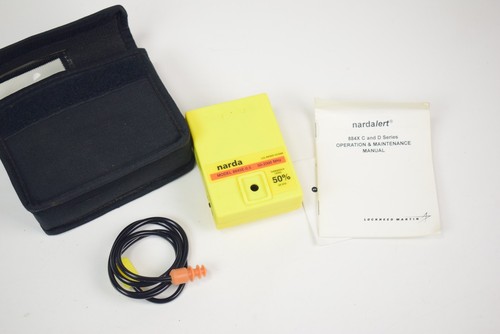
You could get one of these and attach it to your hat.... No doubt it will be flashing and buzzing away... I have same one, -BK = Black, and a UHF portable close by will trip it. It is meant to be belt worn... The one on e-bay is supposed to be 2000 MHz not 200 MHz. There are several different model/frequency ranges.

1648249645690.jpeg
 
Last edited:

k6cpo

Member
Joined
Dec 30, 2013
Messages
1,485
Reaction score
1,027
Location
San Diego, CA
I picked up a inexpensive field strength meter on Amazon to do RF measurements. It's no longer available at the price I paid, but there are other models on there. This would be the way to measure where the areas of exposure might be.
 
Status
Not open for further replies.
Top