• To anyone looking to acquire commercial radio programming software:

    Please do not make requests for copies of radio programming software which is sold (or was sold) by the manufacturer for any monetary value. All requests will be deleted and a forum infraction issued. Making a request such as this is attempting to engage in software piracy and this forum cannot be involved or associated with this activity. The same goes for any private transaction via Private Message. Even if you attempt to engage in this activity in PM's we will still enforce the forum rules. Your PM's are not private and the administration has the right to read them if there's a hint to criminal activity.

    If you are having trouble legally obtaining software please state so. We do not want any hurt feelings when your vague post is mistaken for a free request. It is YOUR responsibility to properly word your request.

    To obtain Motorola software see the Sticky in the Motorola forum.

    The various other vendors often permit their dealers to sell the software online (i.e., Kenwood). Please use Google or some other search engine to find a dealer that sells the software. Typically each series or individual radio requires its own software package. Often the Kenwood software is less than $100 so don't be a cheapskate; just purchase it.

    For M/A Com/Harris/GE, etc: there are two software packages that program all current and past radios. One package is for conventional programming and the other for trunked programming. The trunked package is in upwards of $2,500. The conventional package is more reasonable though is still several hundred dollars. The benefit is you do not need multiple versions for each radio (unlike Motorola).

    This is a large and very visible forum. We cannot jeopardize the ability to provide the RadioReference services by allowing this activity to occur. Please respect this.

Abies

KO6IIN
Joined
Dec 24, 2023
Messages
26
Reaction score
26
Location
Sacramento, CA
Assuming proper installation in all respects, including grounding, is there any value in providing surge protection in the coax line? I'm thinking of a coax switch (one where the off position grounds the antenna line) and/or a standard coax surge protector. The vehicle will often be in the field where there is a possibility of a lightning strike nearby.

What about the DC line going to the radio? Should that have surge protection, or will proper grounding of the system take care of that concern?
 

RFI-EMI-GUY

Member
Joined
Dec 22, 2013
Messages
7,947
Reaction score
5,187
My E350 van that had decades ago with CB (NMO-27) and GMRS (NMO 1/4 wave) actually got struck by lightning while parked outside the window at my office. There was paint damaged at roof near the center brake light and I think the charge went through the frame and trailer hitch to ground where I found a fulgarite in the sandy soil. But miraculously, nothing was damaged.

But yeah, it could get hit and damaged. Grounding everything properly is your first line of defense. As far as protectors on the DC, unless you have some very valuable gear and a fiberglass body, I would not be concerned. An HF antenna of any sort would warrant a protector. I would say it is a risk assessment you need to make. I have in my lifetime two lightning strikes at home. Both causing damage. The second one much more serious. I should have called in my insurance due to later finding my pool light wiring getting knocked out amongst other things.
 

hill

Member
Premium Subscriber
Joined
Dec 19, 2002
Messages
2,133
Reaction score
1,401
Location
Middle River, MD
My E350 van that had decades ago with CB (NMO-27) and GMRS (NMO 1/4 wave) actually got struck by lightning while parked outside the window at my office.
.
After my brother passed away and the lady that got his Hyundai Santa Fe. It got struck by lightning less Then a year later and was totaled with the amount of electronics in modem vehicles.

I wouldn't really worry about this with it being very rare.
 

Abies

KO6IIN
Joined
Dec 24, 2023
Messages
26
Reaction score
26
Location
Sacramento, CA
.
After my brother passed away and the lady that got his Hyundai Santa Fe. It got struck by lightning less Then a year later and was totaled with the amount of electronics in modem vehicles.

I wouldn't really worry about this with it being very rare.

It's not so much a matter of a direct strike, which as you state is rare. Rather, it's a nearby strike which could cause induced current, enough to damage electronics. This is also a factor for base stations; the odds of a direct strike are small compared to those of a nearby strike. I've had two strikes in my lifetime (that I can remember) that were within a couple hundred feet of my residence at the time, and that's living in lowland California where lightning is relatively rare. The mountains are a whole other story in that regard.

My new vehicle (replacing my old 4x4) will often used be in mountainous regions. The best sites there for radio use are ridges and summits (aside from my other reasons for going to such spots such as photography). Of course one should exercise due caution in inclement weather and try to move out of harm's way, but in practice one can be caught by surprise, especially while sleeping.
 

slowmover

Active Member
Joined
Aug 4, 2020
Messages
4,156
Reaction score
4,129
Location
Fort Worth
Big truck manufacturers & fleets make no provision for such.

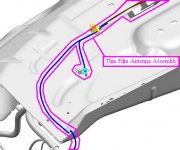
Not all antennas are external. Image is of the composite material above the windshield with a HIRSCHMANN Thin Film Antenna.

IMG_2777.jpeg

On some current fleet trucks are twin mirror-mount whips where one is CB, the other is AM/FM.

On many older trucks are driver/owner aftermarket set/ups. Wide variations.

Strikes can occur. I’ve heard of a few. But the industry as a whole doesn’t regard it as likely.

That’s the largest user group of mobile HF.
The insurers would have a say in things. No one but the driver gives a good G-D if he’s without a CB.

.
 

slowmover

Active Member
Joined
Aug 4, 2020
Messages
4,156
Reaction score
4,129
Location
Fort Worth
Agreed that mountain ridges are another kettle of fish. I’d finish that stew early then move downslope.

Good luck
 

kayn1n32008

ØÆSØ Say it, say 'ENCRYPTION'
Joined
Sep 20, 2008
Messages
7,530
Reaction score
2,501
Location
Sector 001
Assuming proper installation in all respects, including grounding, is there any value in providing surge protection in the coax line? I'm thinking of a coax switch (one where the off position grounds the antenna line) and/or a standard coax surge protector. The vehicle will often be in the field where there is a possibility of a lightning strike nearby.

What about the DC line going to the radio? Should that have surge protection, or will proper grounding of the system take care of that concern?
You are WAY over thinking a problem that really isn't an issue.

Where exactly are you disappating an Induced current to? Your 'ground' is the negative side of a DC power system that is 'floating' independently of the earth. You don't have an 'earth' ground in a mobile instalation, like you would with an AC powered fixed site like a repeater or a home station.
 

hazrat8990

Active Member
Premium Subscriber
Joined
Apr 12, 2013
Messages
552
Reaction score
344
Location
Wyoming
Assuming proper installation in all respects, including grounding, is there any value in providing surge protection in the coax line? I'm thinking of a coax switch (one where the off position grounds the antenna line) and/or a standard coax surge protector. The vehicle will often be in the field where there is a possibility of a lightning strike nearby.

What about the DC line going to the radio? Should that have surge protection, or will proper grounding of the system take care of that concern?
Most commercially made antennas with any sort of loading coil are DC grounded, and will show a dead short if you test them with a multimeter. There's nothing wrong with adding additional grounds, or bonding straps to body panels etc. In fact, it will most likely help with reducing, or eliminating RFI and also help to dissipate static. However, everything can, and probably will be affected by a direct strike.
 

mmckenna

I ♥ Ø
Joined
Jul 27, 2005
Messages
27,651
Reaction score
33,861
Location
United States
I agree, I think you are over thinking this.

I've had some nearby strikes, but never had any issues with the vehicles or the radios. This was everything from CB to VHF, UHF and 800MHz.
What makes a difference is making sure everything is at the same potential.

Permanenet mount antennas where there is a direct connection to the body at the antenna base. As mentioned above, DC grounded antennas might have a slight benefit. There's a small gap at the antenna mount, and the lightning will jump that if it decides it wants to go to the body.

The negative power lead from your radio should go straight to a body ground, not all the way back to the battery.
The positive power lead from your radio should go straight to the battery positive with a suitable fuse/breaker.
I usually run a separate ground from the radio chassis direct to the body ground also.

None of that is specific to lightning, that's just good install practices. Good grounding helps, but like it was said, your vehicle isn't really 'grounded'. Any lightning strike that is going to damage your radio is probably going to make a mess of your car electronics unless you get luckly. Lightning does wierd things.

In all the installation manuals I've read from Motorola, Kenwood and Harris, I've never seen anything that was designed around lightning strikes. But they all shared similar install practices.
 

slowmover

Active Member
Joined
Aug 4, 2020
Messages
4,156
Reaction score
4,129
Location
Fort Worth
A big chunk of metal on a tree-less mountain ridge is even more of a target than a human traversing it.

It ain’t “overthinking”. It was a sensible question.

Generally, not a problem given proper method.
Risk, is location over all else.

IMG_9356.jpeg

.
 

prcguy

Member
Joined
Jun 30, 2006
Messages
17,963
Reaction score
13,557
Location
So Cal - Richardson, TX - Tewksbury, MA
It's not so much a matter of a direct strike, which as you state is rare. Rather, it's a nearby strike which could cause induced current, enough to damage electronics. This is also a factor for base stations; the odds of a direct strike are small compared to those of a nearby strike. I've had two strikes in my lifetime (that I can remember) that were within a couple hundred feet of my residence at the time, and that's living in lowland California where lightning is relatively rare. The mountains are a whole other story in that regard.

My new vehicle (replacing my old 4x4) will often used be in mountainous regions. The best sites there for radio use are ridges and summits (aside from my other reasons for going to such spots such as photography). Of course one should exercise due caution in inclement weather and try to move out of harm's way, but in practice one can be caught by surprise, especially while sleeping.
What make/model is your new vehicle?
 

Abies

KO6IIN
Joined
Dec 24, 2023
Messages
26
Reaction score
26
Location
Sacramento, CA
A big chunk of metal on a tree-less mountain ridge is even more of a target than a human traversing it.

It ain’t “overthinking”. It was a sensible question.

Generally, not a problem given proper method.
Risk, is location over all else.

View attachment 194656

.

The diagram is helpful and contains the standard lightning-safety advice. Still, it doesn't fully express the topographic diversity of situations out there that I've experienced over the decades. For instance, one may be in a very large and generally high area where the valleys may be shallow and not far below the ridges. Or, topography may consist of gently rolling uplands cut by occasional inaccessible river canyons.

I'm confident that maintaining situational awareness and using common sense will be effective in minimizing lightning risk the vast majority of the time, but not always. The disastrous 2020 Creek Fire in California appears to have started from the lightning strike near the bottom of a 2000'-deep canyon, for example.

In some cases weather can sneak up on you. I had that happen to me decades ago. At sunset there were just some puffy small clouds, but later I was extremely surprised to find a lightning storm had started. (The usual thunderstorm pattern in the mountains of California is daytime development of storms, which peak in the afternoon then die down late in the day, though I've seen exceptions to that.)

It all comes down to informed risk management. I know that some of my past choices in retrospect were too risky, but it's also not realistic to always retreat to deep valleys in case something develops overnight. A lot of remote areas don't have internet access, though I may be able to tune in to NOAA weather.


What make/model is your new vehicle?

Ford Bronco. Right now a shop is installing an aftermarket aluminum top. That will provide a good ground plane, unlike the OEM soft top or non-metallic hard top. It should also function like an integrated metal roof in case of a direct strike. I will be sleeping in the vehicle sometimes.
 

enine

Member
Joined
Jan 24, 2006
Messages
223
Reaction score
6
You are WAY over thinking a problem that really isn't an issue.

Where exactly are you disappating an Induced current to? Your 'ground' is the negative side of a DC power system that is 'floating' independently of the earth. You don't have an 'earth' ground in a mobile instalation, like you would with an AC powered fixed site like a repeater or a home station.
Vehicle tires have been made slightly conductive for decades to dissipate static electricity. SO while its not a great ground like a rod in the dirt is still is a ground.
 

ofd8001

Member
Premium Subscriber
Joined
Feb 6, 2004
Messages
8,352
Reaction score
1,466
Location
Louisville, KY
Over my 50 plus years in public safety, I may have heard one occasion where a police car took a direct hit from lightning which fried all the electronic stuff.

The National Fire Protection Association does not call out any special protections for electronic equipment, like radios, from lightning strikes.

I suspect a bigger worry would be things like jump starting and antennas on the receiving end of a static electricity arc.
 

prcguy

Member
Joined
Jun 30, 2006
Messages
17,963
Reaction score
13,557
Location
So Cal - Richardson, TX - Tewksbury, MA
Vehicle tires have been made slightly conductive for decades to dissipate static electricity. SO while its not a great ground like a rod in the dirt is still is a ground.
Lightning may have traveled 15mi to reach your car, another 2ft to the earth is not going to stop it. I think in nearly all cases when an insulated thing like a vehicle gets hit, its just a stepping stone to or from earth ground for the strike.

According to the internet AI bots, millions of cars each year get hit by lightning worldwide. There are approximately 1.4 billion cars, trucks, SUVs in the world so the chances of your vehicle getting hit is extremely small and in my opinion not worth prepping for because you won't know if the things you did to protect it will even work until its hit.
 

mmckenna

I ♥ Ø
Joined
Jul 27, 2005
Messages
27,651
Reaction score
33,861
Location
United States
I can confirm this. Many years ago I was up in the Pacific Northwest driving through a particularly bad storm. Somewhere up ahead of us some poor dude on a motorcycle got hit by lightning. He survived just fine, had a big burn mark down his back. I think I recall that the motorcycle was fine, but it may have been an older bike with dirt simple electrics.

I was also on a ship that got hit by lightning. Radar, radios, everything worked just fine afterwards, but one of the engine control computers for the mains left the chat, all the way down in the engine room.

Lightning doesn't do what man wants, it does its own thing and points and laughs at us while it's doing it.

And directly lightning strikes are not the only concern. Even a nearby strike will do a hell of a lot of damage due
 

prcguy

Member
Joined
Jun 30, 2006
Messages
17,963
Reaction score
13,557
Location
So Cal - Richardson, TX - Tewksbury, MA
I can confirm this. Many years ago I was up in the Pacific Northwest driving through a particularly bad storm. Somewhere up ahead of us some poor dude on a motorcycle got hit by lightning. He survived just fine, had a big burn mark down his back. I think I recall that the motorcycle was fine, but it may have been an older bike with dirt simple electrics.

I was also on a ship that got hit by lightning. Radar, radios, everything worked just fine afterwards, but one of the engine control computers for the mains left the chat, all the way down in the engine room.

Lightning doesn't do what man wants, it does its own thing and points and laughs at us while it's doing it.

And directly lightning strikes are not the only concern. Even a nearby strike will do a hell of a lot of damage due
I've told this story before but I know a guy who lived in Green Mountain Falls, CO and he got hit by lightning in the basement of his three story house. The basement was about 5ft below grade and he was reloading bullets near a ground level window when lightning went through the window, through him into the floor. It left him paralyzed on one side of his body. He owned an gun store in Colorado Springs and had to eventually close up shop due to his injuries.
 

Abies

KO6IIN
Joined
Dec 24, 2023
Messages
26
Reaction score
26
Location
Sacramento, CA
And directly lightning strikes are not the only concern. Even a nearby strike will do a hell of a lot of damage due

This is a key point that keeps getting forgotten in this discussion.

The issue I initially raised is a nearby strike which is far more likely than a direct strike. However, as discussed above the vehicle is a floating ground, unlike an earth-grounded home electronics system. I gather that means that I don't need to be worried about close lightning strikes inducing damaging currents in my vehicle wiring and coax.

In the unlikely event my vehicle is directly hit by lightning, I'm not expecting any preparations I've made will be adequate to avoid property damage. I'll expect the worst and be grateful if the damage is less.
 

mmckenna

I ♥ Ø
Joined
Jul 27, 2005
Messages
27,651
Reaction score
33,861
Location
United States
The issue I initially raised is a nearby strike which is far more likely than a direct strike. However, as discussed above the vehicle is a floating ground, unlike an earth-grounded home electronics system.

Right, you can't do anything with that energy if it decides it likes your radios. Best you can do is get everything as close to the same potential as possible and hope your fuel tank doesn't blow up. Walking away from a direct strike would be the victory lap to end all victory laps. Any damage to the radios/vehicle at that point would be secondary.

I gather that means that I don't need to be worried about close lightning strikes inducing damaging currents in my vehicle wiring and coax.

It would probably energize the vehicle body more than the antenna, since the body is larger and would absorb more.

As mentioned earlier, it's going to arc over to ground and your car/radio/antenna is just a minor speed bump along the way.

I don't know what you'd do to prevent issues in that sort of situation. One could start bonding everything together, install Polyphasers, ground rings, etc. but to what end? The amount of heat, RF and sudden expansion of superheated air is going to be a bigger issue. Ships and aircraft get hit frequently, probably way more than cars/trucks/buses.

Or like you said:

In the unlikely event my vehicle is directly hit by lightning, I'm not expecting any preparations I've made will be adequate to avoid property damage. I'll expect the worst and be grateful if the damage is less.
 
Top