E probe type research for vertical antenna VLF/LF/MF

W1FRV

Member
Joined
Aug 8, 2024
Messages
21
Reaction score
5
In my mind from a long time ago I recall seeing many turns of fine enamel wire on a #75 mix, 2.4" toroid ring.
The ring was wound almost full of fine enameled wire, say #30.
The COLD or bottom of that winding was for common or reference.
The top end had a piece of PC board or wire of a few feet going vertical.
Around the bottom of the winding were several turns of coupling loop which terminated in coax. RG58/6.
The bottom of the large inductor and the cold side of the coupling loop were tied together as common.
The inner of the coax was tied to the other side of the pick up loop.

The antenna was hoisted vertically, say to 50' above ground with RG58/6 coax feed to see common mode decoupling, thence to the shack..

Any bells??

Dave/W1FRV
 

prcguy

Member
Joined
Jun 30, 2006
Messages
17,886
Reaction score
13,426
Location
So Cal - Richardson, TX - Tewksbury, MA
Yes, you just described a typical passive E field VHF/HF antenna. A really super short antenna at VLF/HF under 3ft will be very high impedance like several thousand to a few meg ohm range depending on frequency and a broad band auto transformer matching 50 ohms to a very high impedance can work well with a short whip or PC trace as the E field pickup probe. The AOR SA7000 is an example of this but also has a VHF/UHF side and a diplexer to combine the two antennas.

I think its much better to have an active E field probe where the active device, transistor or IC is not only used in the impedance transforming role but also gives some gain to drive a run of coax. My favorite example of this is the AMRAD active antenna project and you can look over the schematic here: https://www.arrl.org/files/file/Technology/tis/info/pdf/0109031.pdf I built one of these over 20yrs ago and its a great performer.
 
Last edited:

merlin

Active Member
Joined
Jul 3, 2003
Messages
3,795
Reaction score
1,828
Location
DN32su
I have something similar, been looking into an LNA for it. Specs sat it should be good for 60 MHz and down.
I am wanting ELF/VLF. I think just a matter of getting the whip above roof line.
 

W1FRV

Member
Joined
Aug 8, 2024
Messages
21
Reaction score
5
Thanks prcguy,

That was what I used for years and with very good results. Thanks for the article refresh too.
BTW, most maritime mobile receivers used that transistor in the front end for obvious reasons.
For now I'm only looking for 100 khz and below.
I see the passive auto transformer version as a low pass filter coupled to ground level with RG6 for negligible loss.
Adding a suitable ground screen and decoupling the feed to the receiver is a must.
Am asking out there how this works out. I saw it written up someplace but lost the source.
Am tinkering in the mean time and would like to increase reception to 2 mhz.
So far loops are best here for 630m and 160m WSPR. 73s
 

prcguy

Member
Joined
Jun 30, 2006
Messages
17,886
Reaction score
13,426
Location
So Cal - Richardson, TX - Tewksbury, MA
I have something similar, been looking into an LNA for it. Specs sat it should be good for 60 MHz and down.
I am wanting ELF/VLF. I think just a matter of getting the whip above roof line.
I've had an older version of this VLF/HF LNA for years and it works great with passive loops and E field probes.


W1FRV

Member
Joined
Aug 8, 2024
Messages
21
Reaction score
5
So, I have started with a 75 mix, 2.4" toroid winding of 65 mH as the primary E sensor and 100 uH as the secondary feed to receiver.
Next step is to view the noise generator sweep from 10 khz through 1 mhz to see if this is a viability or ball park.
Am looking for best results from 10 khz to 1 mhz. as seen on the SDR sweep..
There is PLENTY of noise out there between galactic, sun, and power lines.
At 475 khz, the average antenna noise here is about 12db going from dummy load to antenna.
No matter what, NAA usually comes in at about 50db S/N at this QTH... ( at best so far )
At 20 khz the secondary looks like 7 Kohms and the primary is 11 ohms. Thinking will do best from 17.2 to 60 khz. target....
??
 
Last edited:

W1FRV

Member
Joined
Aug 8, 2024
Messages
21
Reaction score
5
Thanks prcguy,

That was what I used for years and with very good results. Thanks for the article refresh too.
BTW, most maritime mobile receivers used that transistor in the front end for obvious reasons.
For now I'm only looking for 100 khz and below.
I see the passive auto transformer version as a low pass filter coupled to ground level with RG6 for negligible loss.
Adding a suitable ground screen and decoupling the feed to the receiver is a must.
Am asking out there how this works out. I saw it written up someplace but lost the source.
Am tinkering in the mean time and would like to increase reception to 2 mhz.
So far loops are best here for 630m and 160m WSPR. 73s
 

dlwtrunked

Member
Premium Subscriber
Joined
Dec 19, 2002
Messages
2,672
Reaction score
1,537

W1FRV

Member
Joined
Aug 8, 2024
Messages
21
Reaction score
5
The impedance is critical for E-field antennas and I doubt this will do.
Agree on your premise, D.
This E-Field catcher is a step down transformer from MANY turns on a 75# mix, 2.4" toroid, with a secondary low Z winding headed for a decoupling network, thence to the shack.
Using RG6 drop coax is a blessing at these frequencies cuz @ 20 khz, the loss is only about .2 db / 100'.. ( a gift, and cheap )
Looking good already but must find the proper amount of turns ratio for the 25 khz neighborhood..
Right now the primary is 60 millihenries and the secondary is 300 microhenries, DC isolated. The hi-z primary has it's own ground rod.
Still working this but the loop is best...
The 'stinger' is a 8' mobile whip. Thinking the power lines are a disqualifier.
 

dlwtrunked

Member
Premium Subscriber
Joined
Dec 19, 2002
Messages
2,672
Reaction score
1,537
Agree on your premise, D.
This E-Field catcher is a step down transformer from MANY turns on a 75# mix, 2.4" toroid, with a secondary low Z winding headed for a decoupling network, thence to the shack.
Using RG6 drop coax is a blessing at these frequencies cuz @ 20 khz, the loss is only about .2 db / 100'.. ( a gift, and cheap )
Looking good already but must find the proper amount of turns ratio for the 25 khz neighborhood..
Right now the primary is 60 millihenries and the secondary is 300 microhenries, DC isolated. The hi-z primary has it's own ground rod.
Still working this but the loop is best...
The 'stinger' is a 8' mobile whip. Thinking the power lines are a disqualifier.
Ok, had not really realized you were tacking care of that.
I have used purchased small antennas of two types. Both worked well. Of coursed need to get them away from metal and noise sources. They were similar to the ones below but earlier models.
For PA0RDT Miniwhip Active Antenna VLF LF HF VHF Shortwave RX Assembled | eBay ~$66 with half that being in shipping with the tariffs in that
(I purchased several different models off eBay but the above was clearly the best --the PA0RDT design has always worked fine for me)
and
ELF Antennas | VLF Antennas | LF Antennas | LF Engineering Co. >$200 (U.S. maker in CT)
You might want to get one of these to compare if you do not already have one.
 

W1FRV

Member
Joined
Aug 8, 2024
Messages
21
Reaction score
5
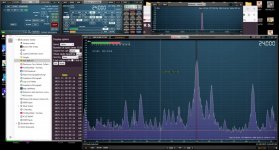
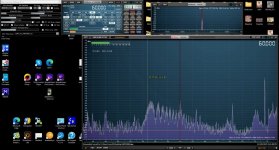
The jury is back in. A 300' wire loop seems to outperform the e-probe. Noisy area this.
Here are some shots of the loop near Boston, yesterday.
 

Attachments

  • NAA+.jpg
    NAA+.jpg
    133.6 KB · Views: 1
  • WWVB60.jpg
    WWVB60.jpg
    120.5 KB · Views: 1

merlin

Active Member
Joined
Jul 3, 2003
Messages
3,795
Reaction score
1,828
Location
DN32su
I played with a couple versions of these E wave antennas. the better is a 20 inch whip feed a two stage preamp. the first is very high impedance input with little gain, that feeds like a buffer with lower impedance, matches 50 or 75 ohm nicely.
Installation is a bit critical, the whip must be above roof line and a good ground to the grounded points.
Then you can add preamp or what may be needed to offset cable loss.
My case, noise was awful, it is very sensitive to anything e-wave. Loops would be a better alternative.
 
Top