Ionosonde's

Status
Not open for further replies.

Sol100

Member
Joined
Dec 28, 2010
Messages
38
Reaction score
0
Location
Perth Australia
Good Day All,
For many years I've been listening to HF radios, starting out when I was young with an eight transistor radio.
The strange signals always had me interested and when you received Chinese or some other language broadcast it was really exciting. After many years my radios became better and recently I bought a Winradio EXCALIBUR WR-G31DDC. It's an amazing bit of gear, some thing that 10 years ago buying any thing that could mimic it's functions would be thousands of $ if indeed you could get anything.
For years I've been listening little chirps that were only transient in nature and that I put down to natural phenomenon "spherics" . With the Excalibur I can see the entire band in real time up to nearly 50 MHz and guess what the transient chirps are not spherics they are man made.
Look at Pic1- there's a continual sweep right through the band and from what I read this is one of the Ionospheric propagation transmitters. How are these people allowed to broadcast on every band?
Some times you can get two scans so it appears that there is more than one transmitter?
Do any of you guys know much about these transmissions?

Apologies if the pic isn't clear it appears to have reduced in size on the up load.

Sol
 

Attachments

  • Pic1.jpg
    Pic1.jpg
    76.3 KB · Views: 854

ka3jjz

Wiki Admin Emeritus
Joined
Jul 22, 2002
Messages
25,872
Reaction score
2,547
Location
Bowie, Md.
There are all sorts of these things throughout the HF spectrum. They're supposed to transmit on a 'non interference basis' (per ITU regulations) but who listens to those these days, hi?

There are other kinds of measurements using HF; a famous one that's heard here on the East Coast of North America - called CODAR - is a royal pain in the neck. It's usually found around 4800 khz and sweeps several khz in either direction with its characteristic swoop sound. You can look up the abbreviation in Wikipedia. It wipes out (or nearly so) broadcast stations transmitting in and around such a system. So much for 'non interference'

best regards..Mike
 

Token

Member
Joined
Jun 18, 2010
Messages
2,516
Reaction score
778
Location
Mojave Desert, California, USA
Ionospheric propagation transmitters. How are these people allowed to broadcast on every band?
Some times you can get two scans so it appears that there is more than one transmitter?
Do any of you guys know much about these transmissions?

Sol100, all ionosondes do not sweep the full HF range, but many do sweep a great deal of it.

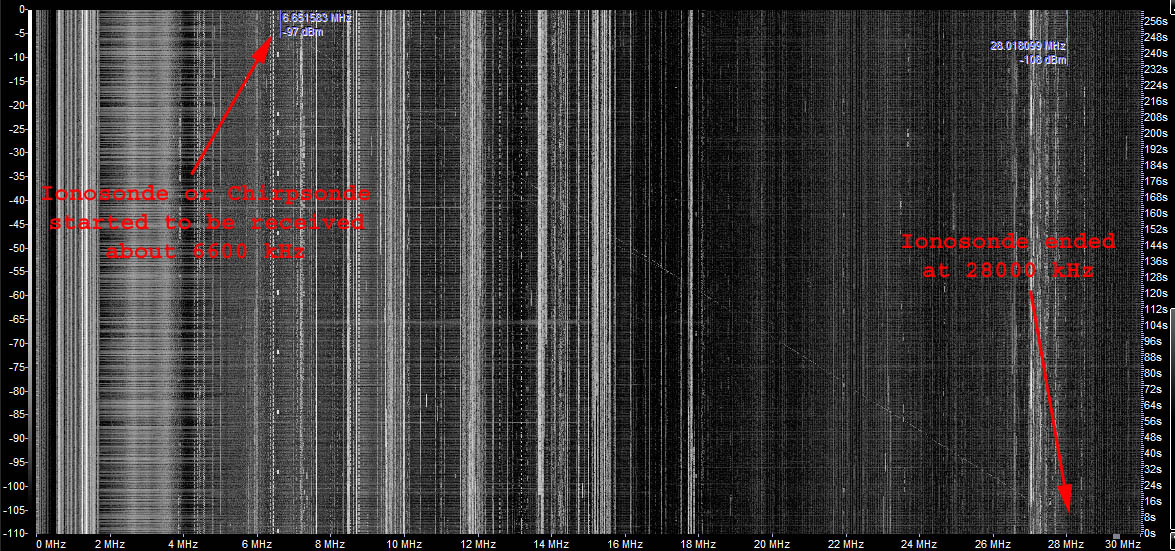
If you look at the whole time of your full spectrum display instead of the 30 seconds shown in the window in your pic (you can do this by sliding the right hand scroll control up and down) you will see the entire sweep for the portions of the band that are open to you at the time. Typically ionosondes sweep from about 3 MHz to 20 MHz, but some go as low as 2 MHz and as high as 30 MHz. None go above 30 MHz that I know of. Most of the time any given location will not see the full sweep because conditions do not exist across the entire band.

Here is a shot of one I caught going from about 6.6 MHz to 28 MHz. If you look closely you will see there are three ionosondes in this picture.
original.jpg


There are dozens of locations around the World that have ionosondes. They are used to test propagation. The following is a good page about them.
Monitoring the World's Ionosondes

Many ionosondes also skip frequencies such as time standard freqs and distress freqs. If you watch 10 MHz and have the width of the DDC window set at about 40 kHz you will see an ionosonde come in on the low side, stop about 10 kHz before the 10 MHz freq, and then restart 10 kHz above the time standard freq.

T!
 

Token

Member
Joined
Jun 18, 2010
Messages
2,516
Reaction score
778
Location
Mojave Desert, California, USA
There are other kinds of measurements using HF; a famous one that's heard here on the East Coast of North America - called CODAR - is a royal pain in the neck. It's usually found around 4800 khz and sweeps several khz in either direction with its characteristic swoop sound. You can look up the abbreviation in Wikipedia. It wipes out (or nearly so) broadcast stations transmitting in and around such a system. So much for 'non interference'

Mike, CODAR is a bane on us all, everyplace. They are also very numerous on the West Coast. Here in the Mohave Desert I can hear up to 60 on any given night and 25 even when the conditions are poor.

For example here are three in a 100 kHz span:
large.jpg


I have a particularly dense section locally that has about 8 CODARs in a 60 kHz range, I need to put a picture of that up sometime.

T!
 

Sol100

Member
Joined
Dec 28, 2010
Messages
38
Reaction score
0
Location
Perth Australia
Hmmmm

Thanks for the reply. People say "you need to get a life" when I bring up any thing to do with radio. The only one interested in sitting in here with me and listening is the cat :eek:)
It's actually refreshing to find some one else that shares what I think is a pretty interesting hobby.
With the new radio it gets pretty difficult to distinguish between some of the sondes and digital signals.
Actually now that I can see what I'm hearing it's absolutely amazing at the amount and variation of signal types.
I did trace one of the wide band signals and it started about 5MHz through (fading out) to 30.
This signal did go straight threw the band and didn't skip 10 or 15 MHz
On some signals I did notice that they appeared to skip some parts of the bands and as you say this might be deliberate.
Now I know what to look for I've found a sweeping signal on about 5.21MHz could drive people crazy. (attachment)
Also notice that Tokken may have a plasma TV close bye, I get the same interference - dam.
Finally, I noticed another phenomenon which I'll raise in another thread shortly. This one has got me scratching my head and I hope some one knows what it is.
In the meantime thanks and keep listening.
Sol
 

Token

Member
Joined
Jun 18, 2010
Messages
2,516
Reaction score
778
Location
Mojave Desert, California, USA
Thanks for the reply. People say "you need to get a life" when I bring up any thing to do with radio. The only one interested in sitting in here with me and listening is the cat :eek:)
It's actually refreshing to find some one else that shares what I think is a pretty interesting hobby.

Actually my primary listening location is in the living room and most typically my wife is no more than 10 feet from me when I have the radios on. She has no interest in tuning around but often is interested in some of the signals I hear.

I have two setups, one in the radio room (a converted spare bedroom since all the kids are grown and gone) that is mostly aimed at ham radio, and one in the living room that is aimed at listening. A picture of my living room shack can be found in this thread http://forums.radioreference.com/pictures-your-shack-mobile-setup/196623-my-living-room-shack.html

With the new radio it gets pretty difficult to distinguish between some of the sondes and digital signals.
Actually now that I can see what I'm hearing it's absolutely amazing at the amount and variation of signal types.

The visual indications actually help me ID a signal quicker than I ever could before. I can often ID a signal off to the side without ever tuning to it to hear it.

When I was first introduced to the waterfall display 30+ years ago it was an eye-opener then, and the last few years of using them at a hobby level has convinced me I would not be happy going back to only an “old” style radio. Sure, I still enjoy tuning a radio around for a relaxing evening, but for serious looking I want a waterfall.

I did trace one of the wide band signals and it started about 5MHz through (fading out) to 30.
This signal did go straight threw the band and didn't skip 10 or 15 MHz
On some signals I did notice that they appeared to skip some parts of the bands and as you say this might be deliberate.

Some jump the time stations, some do not. Some skip other frequencies as well. By looking at what frequency the ionosonde skips you can start to get an idea of who is running it.

Also notice that Tokken may have a plasma TV close bye, I get the same interference - dam.
If you are talking the noise on the left side between about 2 MHz and about 5 MHz, that is not a Plasma TV. The noise repetition interval is far too slow to be a Plasma. Look at the scale on the right side, this image is 260 seconds high, the pulses happen at most a few times a second, sometimes with a second or two between them. I have a Plasma here in the house, and when it is on it wipes HF out from below 1 MHz to over 20 MHz. The closest Plasma any of my neighbors have is about 350 meters away (houses are typically about 200 meters or more apart here), and I can tell when it is on, but just barely and only when looking closely at specific frequencies, it does not show up in the wide band display at all.

T!
 

Sol100

Member
Joined
Dec 28, 2010
Messages
38
Reaction score
0
Location
Perth Australia
Well Token I'm impressed! What a lot of toys :eek:)
I could easily disappear for a looonnnng time with that collection. Just showed a very uninterested wife to prove that I wasn't the only one in the world with a radio :eek:)
Your Mrs must be pretty patient, mine's quite happy to have me in the spare room out of site. Still have the family home even though they're in their late twenties. (I heard a rumor that they do leave one day)
Some of the local Hams that I know have been trying to get me to go for a license. I'm more listener than a talker and besides there's no room for a beam (and a Mrs)
The radio behind the mice, is that a Realistic DX-300? Had one once, should of kept it. Do you find yours a little bit deaf on some bands?
Better get back on subject.
I have noticed with our plasma that the interference pattern changes with what is being shown on the TV screen. Granted that there is always a set back ground noise and it will stay fairly constant if the screen is black or white.
Watching I can see the interference change in time with whats being displayed on the screen it's a pain but not the end of the world.
Interference in my area comes from a few sources...
Pool Chlorinators
Washing machines (there all electronic motor control these days)
Plasma TV's
Touch lamps.
Old CRT monitors or TV's (not many left :eek:) )
Dirty power insulators (on a humid day)
LCD TV's - nowhere as bad as the plasmas
I located my HF aerials up the back yard and I manage to get reasonable reception most times. They have 9:1 matching transformers. Aerial to earth is separate to coax. Where I live in Perth the ground is basically just sand and is a very poor conductor of anything. Houses are wired with what we call MEN (Multiple Earth Neutrals) i.e At the meter box there is a link between the neutral link and that of the earth bar which is also tied to the water pipes. As you can imagine all appliance noise from my house and the neighbors finds it's way to the plumbing.
On some of the Short Wave sites it's recommended that you tie all you radios to earth / ground... do that here and you will get wiped out by noise. Even if you drive an earth stake anywhere near the house forget it. I've found the best results for HF is leaving the radios floating. A long run of coax up to the back yard has given me the best results.
The VHF scanners don't seem to suffer the same problems but saying that when I'm recording the NOAA sats there are some times when interference or intermod randomly occurs. Still working on that one.
Any way it's Australia Day here and a public holiday to boot so it's beer o'clock.
Have a good one all
Sol
 

Mitur

Member
Joined
Dec 14, 2008
Messages
14
Reaction score
2
Location
Khazakstan
How do you tell the difference between QRN and man made QRM? These applications really seem useful and educational. Thanks for posting this! If there is someone here who can maybe use this thread as a base to write about telling the difference and how to read these images, that would be awesome!
 

Token

Member
Joined
Jun 18, 2010
Messages
2,516
Reaction score
778
Location
Mojave Desert, California, USA
The radio behind the mice, is that a Realistic DX-300? Had one once, should of kept it. Do you find yours a little bit deaf on some bands?

That one is a DX-302. I rotate different older radios into the bottom shelf there from time to time. I have at least one example of many of the Radio Shack DX line of desktop radios. DX-75 (although my -75 is in rough shape), DX-100, DX-120, DX-150/150A/150B (each with speaker), DX-160 (with speaker), DX-190, DX-200, DX-300, and DX-302.

Yeah, the 300 and the 302 were not the best radios that could be had, but they were not bad either. And they were some of the first radios I ever owned with digital readout.

Interference in my area comes from a few sources...

I am fairly lucky, QRM at my location is minor. For the most part I have a very low noise floor and very little man-made noise to deal with. However, when it has been 3 or 4 months since the last rain the power lines can get a little noisy with all the dust on the insulators. That builds up slowly and you don’t really notice it until after the first rain, and it is apparent how quiet the radio got all of a sudden.

T!
 
Status
Not open for further replies.
Top