


The AntennaCraft ST-2 scanner antenna is legendary in the scanner world; it was relatively cheap and worked great. They were commonly available at RadioShack, basically since AntennaCraft was a fellow Tandy Electronics subsidiary. There were several ST-Series scanner antennas:
AntennaCraft antennas were also sold by other retailers under that name, I remember seeing them at department stores, CB shops and places like ScannerMaster, FCC Electronics and Olsen Electronics over the years. AntennaCraft also made RadioShack’s TV antennas, which was really their main business.
Back to the ST-2: I have had many over they years. I have written before about grabbing some when RadioShack closed them out. I also got one or two from other scanner hobbyists. When ScannerMaster, for whom I worked at a retirement job for several years, moved to a new facility they cleaned out the warehouse, and I got several more that had been returned by customers. At my peak I had about 10 about 8 years ago. I still have 3, having given a couple away to friends in return for help with projects. I gave two to my buddy Joe after he spent the better part of two days in my attic placing antennas. It must have been fun for him driving across the Valley on his motorcycle with a 5-foot cardboard box tied to his back, on 2 different trips!
I discarded a couple as well after they broke. One was dropped from 25 feet up a ladder not too long ago, one got destroyed as I was relocating it in the attic, catching on a support beam as I wasn’t paying close enough attention.
Of the three I have left, one is in a closet awaiting a possible installation on the side of my house. It had been up there for a while but failed to perform better than the Omni-X that is there now, I later found out that there was a back N-Connector at the patch panel; it wasn’t the fault of the antenna. One of these days I will get out the ladder and swap them again and compare the results. I suspect that I will get better low-band and HF results with the ST-2.
ChannelMaster made a similar style antenna called the “Montenna 5094” that often gets confused with the ST-2. There were a couple other CM model numbers, like the 5094-A and the 5095, the “5094-A” version had the U-Shaped elements while the original (non-A) did not. The 5095 included the 5094-A antenna, a mast, feedline and installation hardware.
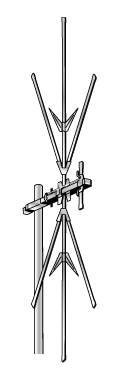
Many people, including myself, have confused the two antennas, at first glance they appear the same. The easiest way to tell the difference is by looking at the UHF elements connected to the main elements: The ST-2 has 2 sets of triangular/pointed ones, only on the center elements. The CH 5094-A series have 6 U-shaped ones, one on each of the 6 main elements. (See illustrations below)
AntennaCraft ST-2:
ChannelMaster Montenna 5094-A:
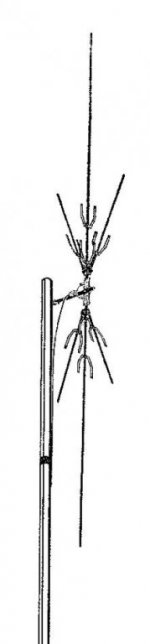
Other than these small elements the antennas share many common design elements, they each have a center boom to which a pair of long vertical main elements attach and act as the feed points. Attached to the main element an inch or so from the boom at a pair of smaller elements at roughly 45-degree angles from the vertical main elements. Both use 300-75-ohm baluns to allow the use of coaxial cable to connect to the scanner. They would come with a 50-foot length of 75-ohm RG59 cable. An adapter would then be needed to connect to the scanner, later units came with an F-BNC adapter, I don’t know if older units came with an F-Motorola adapter or not.
Coax impedance is not nearly as important on scanners as it is on transmitters. In fact, the actual impedance can vary widely depending on the frequency being measure. Don’t fret over 75 or 50-ohm coax, either works just fine for scanners. Over the decades I have used anything from cheap RG-58 and RG-59 to expensive LMR400 and 9913 coax and everything in between. I have found no practical difference between better cables like RG6QS and LMR400 when used for scanners. I am currently using M&P “Air-10” and it works very well although it is exceedingly stiff. I plan on replacing it with SuperFlex this winter.
While neither antenna has been made for years, they remain highly desirable. AntennaCraft closed their doors during the RadioShack bankruptcy in 2015, their small manufacturing facility in West Burlington IA was sold to and repurposed by a local manufacturer of commercial fixtures. ChannelMaster retired their 5094 series scanner antenna line years ago. I reached out to ChannelMaster a while back to see if they were interested in reissuing the 4094-A antenna, but they never replied and I assume they were not interested.
If you have either of these antennas in operation you might want to check the balun, they came with cheap ones and ChannelMaster makes a newer, sturdier and more reliable one, called the Model 3203 (Balun / Matching Transformer Deluxe for TV Antennas | Channel Master). I bought several, they are only $14 and they perform great. I have it going to an F-N adapter to allow my LMR400 cable to attach.
While antennas such as Discones and the Omni-X are currently made and work well, there is a special place in many of our hearts for the ST-2 and CM-5094 antennas. While not the sturdiest antennas around (by a long shot!) they performed very well for scanners. For those of us that listened to low band back in the day they were the best! That long central element gave a lot of capture area. It also worked surprisingly well on HF, with a lot of metal in the air. Since they were built by TV antenna companies they shared a lot of tooling, components and design elements with the more common TV antennas.
It comes up on the RadioReference forums from time to time about home-building copies of the ST-2 or 5094A antennas. A couple members worked on this over the years but so far nothing has panned out. If you are so inclined and have the proper skills and tools it shouldn’t be too difficult to build one, the measurements are easy to find. One guy went so far as to actually design it in AutoCAD and build samples out of better materials but apparently that didn’t go much farther. I have thought about doing something similar, but my construction skills are limited to watching someone else. Should someone succeed in building a properly working replacement I certainly would consider investing in a couple. For now, my remaining ST-2 or Omni-X will have to suffice.
- The ST-1 was an off-center-fed dipole
- The ST-2 (RS 20-044) was a series of center-fed dipoles on a common boom
- The ST-3 (RS 20-176) was a VHF high band quarter-wave with 2 added UHF elements
- The ST-4 (RS 20-043) was a common discone.
AntennaCraft antennas were also sold by other retailers under that name, I remember seeing them at department stores, CB shops and places like ScannerMaster, FCC Electronics and Olsen Electronics over the years. AntennaCraft also made RadioShack’s TV antennas, which was really their main business.
Back to the ST-2: I have had many over they years. I have written before about grabbing some when RadioShack closed them out. I also got one or two from other scanner hobbyists. When ScannerMaster, for whom I worked at a retirement job for several years, moved to a new facility they cleaned out the warehouse, and I got several more that had been returned by customers. At my peak I had about 10 about 8 years ago. I still have 3, having given a couple away to friends in return for help with projects. I gave two to my buddy Joe after he spent the better part of two days in my attic placing antennas. It must have been fun for him driving across the Valley on his motorcycle with a 5-foot cardboard box tied to his back, on 2 different trips!
I discarded a couple as well after they broke. One was dropped from 25 feet up a ladder not too long ago, one got destroyed as I was relocating it in the attic, catching on a support beam as I wasn’t paying close enough attention.
Of the three I have left, one is in a closet awaiting a possible installation on the side of my house. It had been up there for a while but failed to perform better than the Omni-X that is there now, I later found out that there was a back N-Connector at the patch panel; it wasn’t the fault of the antenna. One of these days I will get out the ladder and swap them again and compare the results. I suspect that I will get better low-band and HF results with the ST-2.
ChannelMaster made a similar style antenna called the “Montenna 5094” that often gets confused with the ST-2. There were a couple other CM model numbers, like the 5094-A and the 5095, the “5094-A” version had the U-Shaped elements while the original (non-A) did not. The 5095 included the 5094-A antenna, a mast, feedline and installation hardware.
Many people, including myself, have confused the two antennas, at first glance they appear the same. The easiest way to tell the difference is by looking at the UHF elements connected to the main elements: The ST-2 has 2 sets of triangular/pointed ones, only on the center elements. The CH 5094-A series have 6 U-shaped ones, one on each of the 6 main elements. (See illustrations below)
AntennaCraft ST-2:
ChannelMaster Montenna 5094-A:
Coax impedance is not nearly as important on scanners as it is on transmitters. In fact, the actual impedance can vary widely depending on the frequency being measure. Don’t fret over 75 or 50-ohm coax, either works just fine for scanners. Over the decades I have used anything from cheap RG-58 and RG-59 to expensive LMR400 and 9913 coax and everything in between. I have found no practical difference between better cables like RG6QS and LMR400 when used for scanners. I am currently using M&P “Air-10” and it works very well although it is exceedingly stiff. I plan on replacing it with SuperFlex this winter.
While neither antenna has been made for years, they remain highly desirable. AntennaCraft closed their doors during the RadioShack bankruptcy in 2015, their small manufacturing facility in West Burlington IA was sold to and repurposed by a local manufacturer of commercial fixtures. ChannelMaster retired their 5094 series scanner antenna line years ago. I reached out to ChannelMaster a while back to see if they were interested in reissuing the 4094-A antenna, but they never replied and I assume they were not interested.
If you have either of these antennas in operation you might want to check the balun, they came with cheap ones and ChannelMaster makes a newer, sturdier and more reliable one, called the Model 3203 (Balun / Matching Transformer Deluxe for TV Antennas | Channel Master). I bought several, they are only $14 and they perform great. I have it going to an F-N adapter to allow my LMR400 cable to attach.
While antennas such as Discones and the Omni-X are currently made and work well, there is a special place in many of our hearts for the ST-2 and CM-5094 antennas. While not the sturdiest antennas around (by a long shot!) they performed very well for scanners. For those of us that listened to low band back in the day they were the best! That long central element gave a lot of capture area. It also worked surprisingly well on HF, with a lot of metal in the air. Since they were built by TV antenna companies they shared a lot of tooling, components and design elements with the more common TV antennas.
It comes up on the RadioReference forums from time to time about home-building copies of the ST-2 or 5094A antennas. A couple members worked on this over the years but so far nothing has panned out. If you are so inclined and have the proper skills and tools it shouldn’t be too difficult to build one, the measurements are easy to find. One guy went so far as to actually design it in AutoCAD and build samples out of better materials but apparently that didn’t go much farther. I have thought about doing something similar, but my construction skills are limited to watching someone else. Should someone succeed in building a properly working replacement I certainly would consider investing in a couple. For now, my remaining ST-2 or Omni-X will have to suffice.


