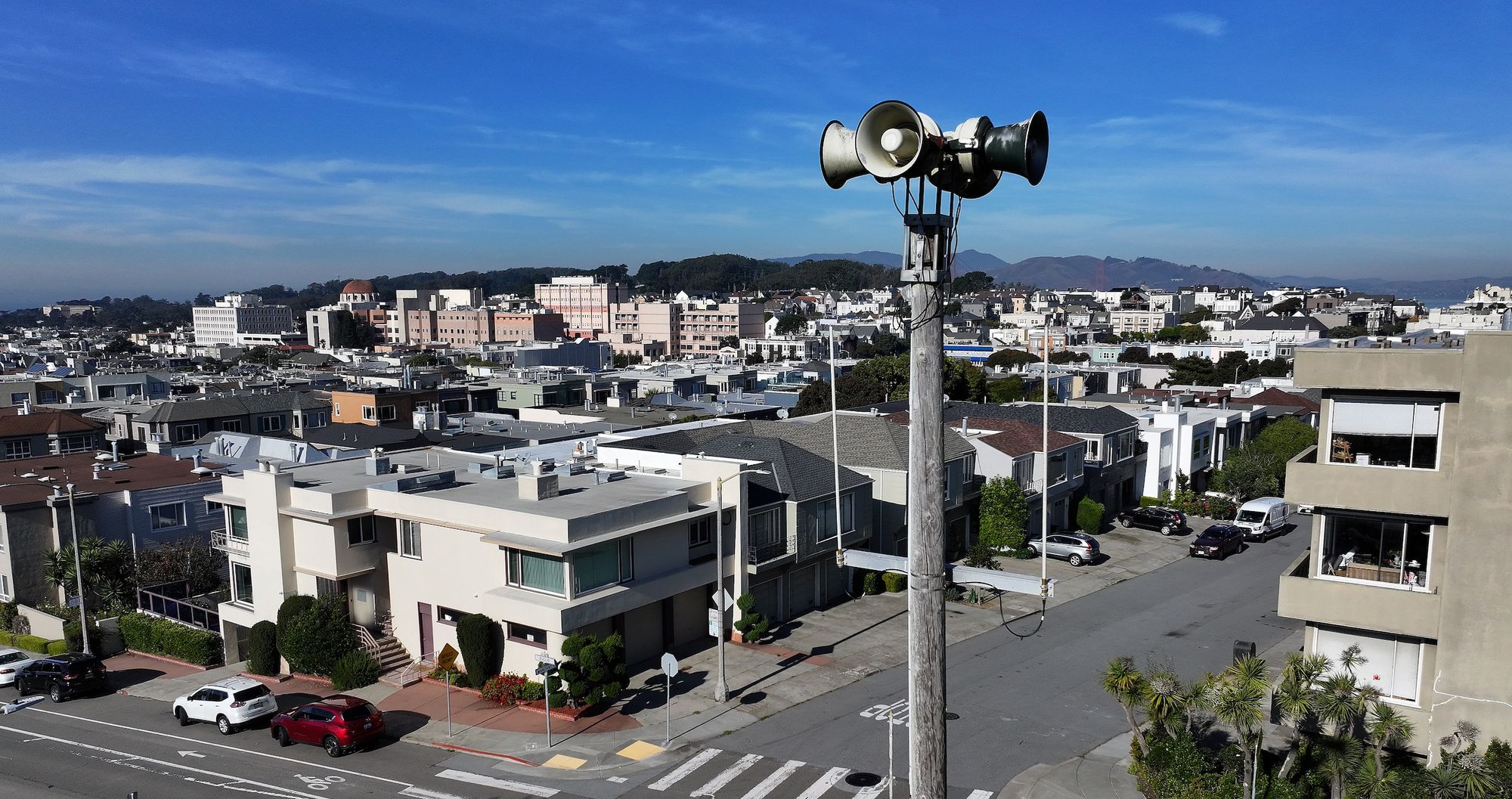
SF Outdoor Warning System

rustyhodge

I like to listen
Premium Subscriber
Joined
Aug 25, 2009
Messages
159
Reaction score
102
Location
San Francisco
Any rumors or insights on the state of the SF Outdoor Emergency Warning System (aka the SF Siren)?

It seems like the city and ATI were pointing fingers, the city was waiting for the P25 encrypted rollout to have the ATI units updated, but then were saying that ATI didn't support P25, yet ATI (Ray Bassiouni) told me that they systems are in use in several locations on encrypted P25 systems, and his company was supposedly waiting for SF to get the funding back in September 2023. In August 2023 there was a lot of politicians talking about getting funding the finish upgrading the system (after the Lahaina tragedy) but now seems attention has faltered.
 

rustyhodge

I like to listen
Premium Subscriber
Joined
Aug 25, 2009
Messages
159
Reaction score
102
Location
San Francisco
Thanks for posting that. Good timing.
Here's what the head of the Department of Emergency Management promised in that meeting six months ago.

"I think we expect in the next six months that the project will be well on its way," said Executive Director Mary Ellen Carroll.

Yet, here we are in February 2024 with nothing to report.
But this annoyed me:
The San Francisco Department of Technology did an assessment and determined that "most of the equipment was non-functional."
Non-functional because they turned them all off? Many (most?) seemed to be solar powered with batteries. Perhaps when they shut them off they turned off the charge controllers as well, and now the batteries are dead.
Or maybe non-functional because the old radio system the relied on has been turned off?
 

rustyhodge

I like to listen
Premium Subscriber
Joined
Aug 25, 2009
Messages
159
Reaction score
102
Location
San Francisco
I've gotten an email from ATI, and here's what I've learned:

The city agency responsible for the sirens (I think DTIS is the SF Department if Technology?) inspected the current sirens and found over 60% require full replacement because "water has been sitting in the equipment".

Which implies that they stopped doing any maintenance or inspections at all(!) while the systems were shut down.

I find it hard to believe that the actual outdoor speaker modules, of which there are 8 on each "siren", are actually degraded as they're designed to be outdoors in challenging weather. It sounds more like the "control boxes" that usually site on the pole (below the speakers) have somehow lost their weather integrity. Perhaps they weren't closed back up fully when they were all disabled. I assume these boxes contain the driver/amplifiers, the radio and control interfaces, and the batteries and solar charge controllers.

That being said:

ATI has sent a proposal to the city to to replace all the sirens for $5 million, here's the breakdown:
  • ATI Systems Siren Replacement Cost: $15,000.00 per siren or $1,785,000.00 for hardware replacement of 119 sirens:
    (Unit price based on ATI-GSA pricing which the city is entitled for as a local Government.)
  • ATI Cost of the engineering for 119 siren is $350,000.00
  • ATI Cost of advanced radio system by Motorola is $535,500.00.
  • ATI Cost of hardware installation (remove old/mount new) for each siren $15,000.00 per unit. Total cost of installation $1,785,000.00
  • ATI Miscellaneous cost: $500,000.00.
ATI Systems Budgetary Cost of Total System Replacement:

ATI Systems Cost (119) Sirens $4,995,500.00
 

rustyhodge

I like to listen
Premium Subscriber
Joined
Aug 25, 2009
Messages
159
Reaction score
102
Location
San Francisco
Here's some more from the letter responding to Supervisor Aaron Peskin and copied to the media:

San Francisco's Siren Emergency System
Background:


- In 2004: Acoustic Technology, Inc. (ATI. Systems) replaced the original
San Francisco siren system, which had been built after WW2 with a
modern siren system. At that time ATI Systems conducted extensive
acoustical field studies around San Francisco to provide reliable acoustic
coverage for the for the entire city, including the Tsunami prone Areas.

- In 2019: The city decided to shut down the system due to hacking threats.

- September 1, 2023: After the Maui fires and subsequent loss of life, the
city of San Francisco contacted ATI Systems, Inc. with renewed interest in
turning sirens back on.

- ATI has reported to the city that over the past several years, ATI
Systems has completely enhanced our technology and implemented full
encryption protocols. With ATI’s next generation encryption solution, the
possibility of our system being breached is negligible.

- These encryption and security improvements have been successfully
tested and will be implemented during the San Francisco siren upgrade.

- The city reported that they inspected the current siren equipment and
found over 60% require full replacement because water has been sitting
in the equipment.

- If the ATI current siren solution were completely replaced, our next
generation, state-of-the-art siren system can be installed and
implemented for a fraction of the costs being estimated by the city.

- ATI has already performed an extensive acoustical study on the City of
San Francisco. Allowing for growth and change in the city, we believe
that a revised acoustic study will show that the vast majority of the
current pole locations can be re-purposed to be used in the siren
upgrade. This will save the city a great deal of money over implementing
all new siren locations.

- In addition, ATI can determine which of the existing siren equipment can
be reused in a new siren solution. Even a lesser percentage of this
hardware could save the city substantial funding.
 

rustyhodge

I like to listen
Premium Subscriber
Joined
Aug 25, 2009
Messages
159
Reaction score
102
Location
San Francisco
Over year later, still no sirens.

Not sure where that $20 million figure comes from, when ATI quoted the city $5 mil to upgrade them all.
 

rustyhodge

I like to listen
Premium Subscriber
Joined
Aug 25, 2009
Messages
159
Reaction score
102
Location
San Francisco
I wrote up a little history of what's happening with the current SF Siren system. It was part of an email I sent to both the Mayor's office and my supervisor. It seemed timely to bring this up again after what had happened in Texas this week.

If you live in SF and are interested in seeing the SF Siren/Outdoor Warning System come back online, I urge you to write to your supervisor as well as the Mayor's office.
  • In 2004: Acoustic Technology, Inc. (ATI Systems) replaced San Francisco’s original outdoor warning siren system—originally built after World War II—with a modern electronic siren system. At the time, ATI conducted extensive acoustical field studies throughout the city to ensure reliable coverage, including tsunami-prone areas.
  • March 2005: The new Outdoor Warning System was activated. “Sixty-five sirens went off at high noon all around the city to introduce the new warning system, which is designed to tell the citizenry that something very bad has happened or is about to,” reported the San Francisco Chronicle. The system included both sirens and voice messages.
  • April 2017: An unknown hacker triggered the city of Dallas’s emergency sirens, which were manufactured by ATI competitor Federal Signal. The incident, which occurred early on a Saturday morning, was not due to a computer hack, but rather someone transmitting a simple code over an unencrypted radio channel.
  • 2019: San Francisco decided to shut down its siren system due to concerns over similar hacking vulnerabilities. Although the Dallas and San Francisco systems were from different manufacturers, San Francisco’s system also relied on unencrypted analog two-way radio signals. It was relatively easy for a bad actor to broadcast the activation code. At the time, the system was expected to be back online within two years.
  • Cause of delay: A major reason for the delay in upgrading the system was the city’s transition to a fully digital, encrypted P25 trunked radio system. That radio infrastructure began rollout in late 2021 and was fully operational by December 2021.
  • January 2022: During a tsunami warning, first responders had to physically go to Ocean Beach with loudspeakers to warn residents.
  • By 2022, though the system was finally capable of working with the new encrypted radio infrastructure, budget constraints redirected funding away from the siren upgrade.
  • February 2023: The Department of Emergency Management (DEM) proposed a $2 million plan to upgrade just 27 sirens in coastal tsunami-prone areas. The plan was rejected by the Capital Planning Committee, a group of 11 city officials and department heads.
    [Source: Disaster sirens still silent after 4 years, with no funding in sight]
  • September 1, 2023: Following the deadly Maui wildfires and public concern over the lack of warnings, San Francisco re-engaged ATI Systems with renewed interest in reactivating its sirens.
  • February 2024: I personally contacted Ray Bassiouni (CEO of ATI Systems) at ray@atisystem.com. He reported that ATI had significantly upgraded its technology, including full encryption protocols. “With ATI’s next-generation encryption solution, the possibility of our system being breached is negligible.”
    • ATI confirmed these security enhancements were successfully tested and would be included in San Francisco’s upgrade.
    • The city inspected its existing sirens and found over 60% had suffered water damage and required full replacement.
    • ATI proposed that if the entire system were replaced, their next-generation solution could be implemented at a fraction of the city’s internal estimates.
    • Because ATI had already performed a comprehensive acoustical study of San Francisco, they believe most existing siren pole locations could be reused—saving the city considerable money.
    • ATI also committed to assessing which existing hardware might still be reusable, even partially, to further reduce costs.
    ATI provided the following cost estimate:
    ATI Systems Budgetary Cost of Total System Replacement: $4,995,500
    • Hardware replacement (119 sirens): $15,000/unit = $1,785,000
      (based on ATI-GSA pricing available to local governments)
    • Engineering (119 sirens): $350,000
    • Advanced Motorola radio system: $535,500
    • Installation (removal and mounting of sirens): $15,000/unit = $1,785,000
    • Miscellaneous costs: $500,000
    Phase 1 Estimate (27 coastal sirens): $1,146,062
  • July 2025: Over 100 people, including 28 children, died in an extreme flooding event in Texas. Many of the children were attending a summer camp in an area with no cell coverage. Most people did not receive flash flood notifications due to various system failures—and there was no outdoor warning system to serve as a backup.
 

MoSiren1

Newbie
Feed Provider
Joined
Apr 6, 2024
Messages
2
Reaction score
0
Location
Springfield, MO
I can say that ATI isn’t the best choice for a siren system. There’s a small county in Illinois that recently upgraded to ATI, and they’re having so many issues that the local city leaders want the system removed—but the county won’t allow it. SF is getting scammed hard. If it were up to me, I’d go with Federal Signal or Sentry Siren. They’re much more reliable for large systems. Federal Signal’s Modulator series. And Sentry Sirens SV Series. Modulator Siren Product Sentry Siren SV
 

rustyhodge

I like to listen
Premium Subscriber
Joined
Aug 25, 2009
Messages
159
Reaction score
102
Location
San Francisco
SF has an existing ATI system, which is why I mention them. I know Hawaii uses the Federal Modulator series they work very well, at least as sirens.
 

rustyhodge

I like to listen
Premium Subscriber
Joined
Aug 25, 2009
Messages
159
Reaction score
102
Location
San Francisco
Meanwhile, earlier this week, there was a major power outage that took out over a third of the city and caused the cell system to get overloaded and many cell sites went down. Kind of showing that relying on cellular infrastructure for emergency updates is not the best.
 

Noob_76555

Member
Joined
Nov 30, 2025
Messages
21
Reaction score
8
Location
Santa Clara County, CA
I'm sure San Francisco's ATI system would work if they planned it correctly. Last time I went there to get some pictures of ATI sirens they're just sitting there and seemed relatively intact. But it seems like budget is a huge barrier here and despite SF having their own P25 system to possibly use the sirens on nothing much is expected.
 

rustyhodge

I like to listen
Premium Subscriber
Joined
Aug 25, 2009
Messages
159
Reaction score
102
Location
San Francisco
I'm sure San Francisco's ATI system would work if they planned it correctly. Last time I went there to get some pictures of ATI sirens they're just sitting there and seemed relatively intact. But it seems like budget is a huge barrier here and despite SF having their own P25 system to possibly use the sirens on nothing much is expected.
It worked in the past for years with no issues. It was just the "speaker hijacking" potential due to the unencrypted controls that were the issue.
A bigger issue is it's been more than 5 years now with no maintenance at all on the system, and one of them lost a speaker (fell down!) a while back.

This photo was from Reddit. taken during the windstorms 2 months ago, across from beach chalet at ocean beach:
 

Attachments

  • deadsiren1.jpg
    deadsiren1.jpg
    27.6 KB · Views: 18
  • deadsiren2.jpg
    deadsiren2.jpg
    154.5 KB · Views: 18

prcguy

Member
Joined
Jun 30, 2006
Messages
18,586
Reaction score
14,718
Location
So Cal - Richardson, TX - Tewksbury, MA
This sounds very typical of how things are managed in CA where incompetent people are in charge of projects, they probably gave contracts to friends who were not qualified and bad city/state Govt decisions put the nail in the coffin. And now they want to spend more of your tax $$ to fix it. And the older system that was put in around 1950 ran for how long?
 

Noob_76555

Member
Joined
Nov 30, 2025
Messages
21
Reaction score
8
Location
Santa Clara County, CA
It worked in the past for years with no issues. It was just the "speaker hijacking" potential due to the unencrypted controls that were the issue.
A bigger issue is it's been more than 5 years now with no maintenance at all on the system, and one of them lost a speaker (fell down!) a while back.

This photo was from Reddit. taken during the windstorms 2 months ago, across from beach chalet at ocean beach:
Now that SF had their own P25 systems for years they could potentially use some encrypted talkgroups to make the controllers work. However, I don't really know how the electronic activation of sirens works, but judging by how previously they used analog unencrypted signals to activate, that wasn't a good idea. It does seem like all this inactivity has done some pretty bad damage especially with some of the heavy rain we've been getting. It's a similar thing down here in San Jose, there's all inactive old 1950s sirens which probably still work if there was someone to care about them. Nowadays I don't really know where all the money goes to support development in our area.
 

rustyhodge

I like to listen
Premium Subscriber
Joined
Aug 25, 2009
Messages
159
Reaction score
102
Location
San Francisco
This article is disappointing and shows that SF is doubling-down on giving up on the sirens.

Emergency sirens in SF won't sound alarm even during Iranian drone threat​

Gillian Mohney
An FBI warning of a potential drone attack by Iran on California has put a spotlight on San Francisco’s famous emergency sirens.
Familiar to residents and alarming to tourists, the piercing wail of sirens used to be a staple in the city during the weekly test on Tuesday at noon. Although this type of alarm — reminiscent of an air raid siren — may feel like a useful way to warn of a drone attack, they are expected to remain silent for the foreseeable future.
The San Francisco Department of Emergency Management shut the sirens down over hardware and security issues in 2019. Originally expected to be upgraded at a cost of $2 million to $2.5 million, the repairs were never completed and the sirens remain silent.
In 2023, they were briefly poised for a comeback after then-Supervisor Aaron Peskin planned to introduce legislation that would fund the repairs. However, the work was never started, with Peskin telling SFGATE in early 2024 they were not added to Mayor London Breed’s budget for the city despite her earlier support for Peskin’s legislation.
Today, the San Francisco Department of Emergency Management said it has a variety of methods to alert local residents of public safety dangers without relying on sirens.


“San Francisco uses a combination of technologies and methods — including Alert SF, Wireless Emergency Alerts, social media, community networks, and public safety vehicles equipped with public address systems and lights,” Jackie Thornhill, a spokesperson for the department, said in an emailed statement. “These tools were used successfully to evacuate Ocean Beach and the Great Highway in December, 2024 during a tsunami warning. We remain committed to reaching as many people as effectively as possible in an emergency and continue to build on our alert and warning programs.”
Thomas Cova, a professor in the school of the environment, society and sustainability at the University of Utah, told SFGATE that sirens “are excellent at breaking people out of their routine,” but can also cause issues if people don’t have enough information.
“You want everybody to just stop doing what they’re doing and pay attention, and so they’re great at that,” he said. “… But if you just set off sirens in an urban area, and they’re supposed to be for different hazards, they don’t help much.”
A siren going off in San Francisco could in theory alert to a wildfire risk, tsunami, earthquake or terrorist attack, and Cova said people need the right information about a threat to respond appropriately.
“There’s a lot of research showing that if you give people a warning without enough information for them to take action, you create a lot of confusion, which is kind of what sirens are famous for,” he said.
Cova said many cities in the U.S. now rely on text alerts similar to AlertSF to warn people of potential dangers. He pointed out that there are two types of alerts, one sent via a cellular network that people can sign up for and wireless emergency alert such as Amber Alerts that are sent via radio waves to everyone in a specific area.
“The text messaging is superior because it comes with information, you know, it can come with, ‘What is the threat? Who is at risk? What can you do?’” he said.
Cova said there are still problems with the wireless text messaging alerts, including issues with power outages and the fact that some people in areas where the radio waves can’t reach won’t get alerts, and that the alerts may not help people with hearing or visual impairments. He also pointed out the long-standing Emergency Alert System is still in use and can preempt radio and TV programming but is much less effective at reaching a large population since so many people use streaming and apps for entertainment.
In the future, he said, wireless alerts could come from satellites like Starlink, which would help reach nearly everyone in an area. But Cova explained that today, the hope is people who do get the messages can then help others who may have missed the alert.
“We hope that people take care of each other, check on each other,” he said.
 
Top