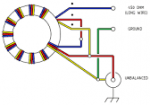
Static drain for outside long wire antenna

Status
Not open for further replies.

Ubbe

Member
Joined
Sep 8, 2006
Messages
10,778
Reaction score
4,560
Location
Stockholm, Sweden
We began the discussion on how to get rid of static charges at the input to a tecsun receivers input. Not armwrists, high ohm transmit antennas at the other end of an antenna tuner, as there's no transmitter with high Z output that I know of. I havent really seen any antenna tuner that hasn't got a DC path to ground somewhere between antenna and radio.

/Ubbe
 

prcguy

Member
Joined
Jun 30, 2006
Messages
18,093
Reaction score
13,849
Location
So Cal - Richardson, TX - Tewksbury, MA
Using a resistor for draining static from an antenna has been figured out a long time ago and around 1meg ohm is usually recommended. Some people put that at the antenna and some like to deal with the static at the radio end. The other examples were to back up the 1meg ohm value.

We began the discussion on how to get rid of static charges at the input to a tecsun receivers input. Not armwrists, high ohm transmit antennas at the other end of an antenna tuner, as there's no transmitter with high Z output that I know of. I havent really seen any antenna tuner that hasn't got a DC path to ground somewhere between antenna and radio.

/Ubbe
 
Last edited:

KC1LML

Member
Joined
May 23, 2019
Messages
44
Reaction score
12
Location
Peterborough, NH
Mechanically speaking, what's the best way to put a 1meg ohm resistor at the radio end? My 2meter/70cm transceiver has a SO-259 jack and my antenna cable has a PL-259 plug. I could build a small box with matching connectors and put the resistor inside. Or is there some kind of in-line adapter that comes with a static drain resistor?

When I redo my long wire antenna for MW reception, I plan to connect it to coax, lightning arrester, etc., and bring it into the house with a PL-259 plug, as well.
 

Boombox

Member
Joined
Sep 2, 2012
Messages
1,541
Reaction score
540
Interesting ideas here, especially the choke and the 1 meg resistor. When I remount my 100 ft. wire, I shall have to consider that.
 

Ubbe

Member
Joined
Sep 8, 2006
Messages
10,778
Reaction score
4,560
Location
Stockholm, Sweden
Mechanically speaking, what's the best way to put a 1meg ohm resistor at the radio end?
The first thing you'll need to do are to make a resistance measurement on your radios antenna connector. Chances are very high that you alredy have a DC path to ground.

/Ubbe
 

prcguy

Member
Joined
Jun 30, 2006
Messages
18,093
Reaction score
13,849
Location
So Cal - Richardson, TX - Tewksbury, MA
I think a VHF/UHF antenna would have less of a problem with static buildup as a much larger HF antenna. Many VHF/UHF antennas have a DC ground anyway and would help bypass static electricity. Most HF end fed long wire antennas these days have a matching transformer of some sort and that will usually have a DC path to ground if its a 9:1 or similar transformer. If you just have a single wire that attaches right to your radio then you would have to deal with it at the radio end.

If you must add a static bypass I would try and put the choke or resistor at the antenna if possible, that way it can protect any radio you connect to it. You can also solder it across the antenna connector inside your radio.

Mechanically speaking, what's the best way to put a 1meg ohm resistor at the radio end? My 2meter/70cm transceiver has a SO-259 jack and my antenna cable has a PL-259 plug. I could build a small box with matching connectors and put the resistor inside. Or is there some kind of in-line adapter that comes with a static drain resistor?

When I redo my long wire antenna for MW reception, I plan to connect it to coax, lightning arrester, etc., and bring it into the house with a PL-259 plug, as well.
 

MisterLongwire

Amateur radio operator/QC tech for radio mfr.
Banned
Joined
Jan 1, 2014
Messages
578
Reaction score
166
Location
San Marcos,Escondido, CA.
Hmm...spark plug...isn't that why it was used back in the old days of ham radio? I remember a guy long ago telling me of that remedy
 

jonwienke

More Info Coming Soon!
Joined
Jul 18, 2014
Messages
13,409
Reaction score
3,728
Location
VA
You'll fry the radio before you build up enough voltage to arc across the spark plug.
 

MisterLongwire

Amateur radio operator/QC tech for radio mfr.
Banned
Joined
Jan 1, 2014
Messages
578
Reaction score
166
Location
San Marcos,Escondido, CA.
I know that. All it really does is shunt some of the electricity.It wasn't a real "spark plug" per say, more of a modified surge protector. I have 2 Eaton's at my station and has served me well. My rigs are too expensive for me to skip the protection
 
Joined
Mar 30, 2019
Messages
295
Reaction score
340
You'll fry the radio before you build up enough voltage to arc across the spark plug.

Hmmm.. I have never had a receiver "fry" using a spark plug... Depends on two things; gap and keeping it out of the weather... Been using this method for over 40 years...

What then, may I ask is a "gas filled discharge tube"? Same damn thing with gas keeping moisture and oxygen from contaminating the points.. I guess in your world they will allow your radio to "fry" too!??????? Please do some research before you open your mouth and.............
Oh and have you ever... Nah, I'll bet not..

They don't call me "StaticDischarge" for nothin...
 

Hit_Factor

Member
Premium Subscriber
Joined
Mar 6, 2010
Messages
2,681
Reaction score
1,450
Location
Saint Joseph, MI
Hmmm.. I have never had a receiver "fry" using a spark plug... Depends on two things; gap and keeping it out of the weather... Been using this method for over 40 years...

What then, may I ask is a "gas filled discharge tube"? Same damn thing with gas keeping moisture and oxygen from contaminating the points..
I think you made his point for him. Simply using a spark plug without dealing with additional factors, such as those addressed by a gas filled discharge tube could result in damage to the radio.

Using a spark plug for 40 years might also be a sign of good luck.
 
Joined
Mar 30, 2019
Messages
295
Reaction score
340
I think you made his point for him. Simply using a spark plug without dealing with additional factors, such as those addressed by a gas filled discharge tube could result in damage to the radio.

Using a spark plug for 40 years might also be a sign of good luck.

Not knowing what one is saying is the only point I see really being made here...

Luck has nothing to do with it...
 

jonwienke

More Info Coming Soon!
Joined
Jul 18, 2014
Messages
13,409
Reaction score
3,728
Location
VA
The other point being newer radios are more susceptible to static damage than older tube-based models...never saw a tube come in a static shield bag...

And gas discharge tubes also break down at a lower voltage than air.
 
Last edited:

ArloG

Member
Joined
Feb 14, 2020
Messages
382
Reaction score
137
Just a silly question. Doesn't an unun take care of the whole static drain thing?
 

jonwienke

More Info Coming Soon!
Joined
Jul 18, 2014
Messages
13,409
Reaction score
3,728
Location
VA
It can, if it provides a DC path to ground on the antenna side.
 

MUTNAV

Active Member
Premium Subscriber
Joined
Jul 27, 2018
Messages
1,514
Reaction score
1,496
yup.... as a static drain it looks like it would be good to me.

We're talking static from wind and such right?

Thanks
Joel
 

jonwienke

More Info Coming Soon!
Joined
Jul 18, 2014
Messages
13,409
Reaction score
3,728
Location
VA
Yes. Not going to help much if you get a direct lighting hit.
 
Status
Not open for further replies.
Top