

You are using an out of date browser. It may not display this or other websites correctly.
You should upgrade or use an alternative browser.
You should upgrade or use an alternative browser.
VHF TV Antenna
- Thread starter greg662
- Start date


mmckenna
I ♥ Ø
Often there's a pair of wing nuts that the 300Ω twin lead would connect to.
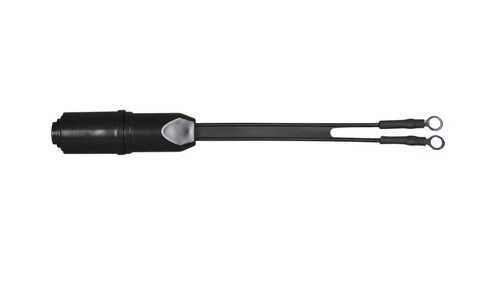
Installation would often use a 300Ω to 75Ω balun to covert from the twin lead to coax:
 www.solidsignal.com
Installation would often use a 300Ω to 75Ω balun to covert from the twin lead to coax:
Winegard 300-75 OHM Weatherproof Matching Indoor Outdoor Transformer (TV-2900)
Winegard 300-75 OHM Weatherproof Matching Indoor Outdoor Transformer (TV-2900)Experience the seamless connection of your 300-OHM antenna output to 75-OHM coaxial cable with the Winegard 300-75 OHM Matching Indoor Outdoor Transformer (TV-2900). This high-quality transformer is designed to provide...
www.solidsignal.com
Ubbe
Member
Looks like a dual band antenna, low VHF and high VHF and the active elements are the ones with plastic insulators. It should probably be a plastic box attached to those two pins at the top, for 200MHz VHF high, that ends nowhere and where the coax should go. The low dipole with the U metal piece are probably the 60MHz low VHF that should probably have a coax that then goes to the diplexer filter box to combine both antenna sections to one coax. As parts seems top be missing it could be some issues trying to use the antenna.
/Ubbe
/Ubbe
That makes sense. Can the missing part be purchased or constructed? The antenna is around 10 feet long (two smaller sections that connect together). I'm wondering whether the antenna is worth saving or not. I would rather not discard it if it has any use. Many channels are UHF now, but I think a VHF antenna also picks up FM stations.

MiCon
Mike
If it's missing parts, you'd probably be better off going on e-bay or Amazon and get a new one, or at least a used one with all of the parts.
As for using an old-style TV antenna for a scanner, it will work as long as you work out the details for converting the twin lead 300ohm to 50 or 75ohm coax. They were made for the upper end of VHF-low (65 ~ 80mhz), and and around 190~215 mhz VHF-high. The newer versions also had UHF elements added.
They are directional, so your best reception would be at the front or rear of the antenna. Signals coming from the sides of the antenna will be reduced.
Also, they are meant to be mounted horizontally, to receive the horizontally transmitted TV signal. They will still receive a vertically transmitted signal, but if you can mount it vertically, reception will be better. And of course, mounting it in the attic or on the roof will increase your reception.
My personal opinion is that it's not a great general purpose antenna, but it would make a good directional antenna.
<>< Mike
As for using an old-style TV antenna for a scanner, it will work as long as you work out the details for converting the twin lead 300ohm to 50 or 75ohm coax. They were made for the upper end of VHF-low (65 ~ 80mhz), and and around 190~215 mhz VHF-high. The newer versions also had UHF elements added.
They are directional, so your best reception would be at the front or rear of the antenna. Signals coming from the sides of the antenna will be reduced.
Also, they are meant to be mounted horizontally, to receive the horizontally transmitted TV signal. They will still receive a vertically transmitted signal, but if you can mount it vertically, reception will be better. And of course, mounting it in the attic or on the roof will increase your reception.
My personal opinion is that it's not a great general purpose antenna, but it would make a good directional antenna.
<>< Mike
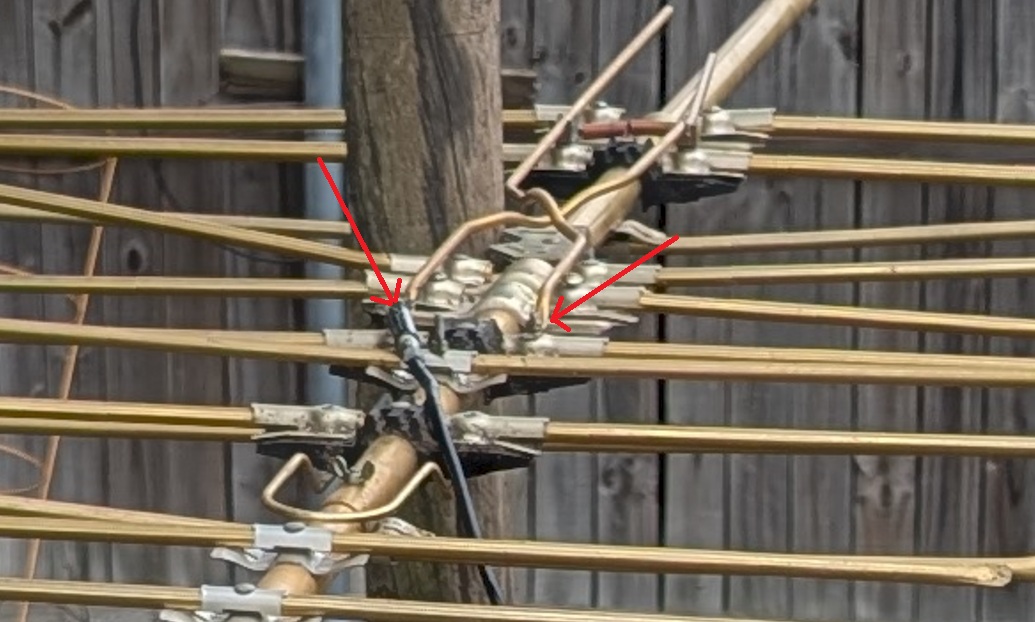
Here is a picture of the entire antenna. There are four of the small U-shaped antennae on the VHF low end. I don't know if these should be connected in some way. I will try to connect to the larger piece that crosses like an open figure-8 and see if I get any signal.

Ubbe
Member
At what frequencies? What do you compare it to?I get a very good signal.
/Ubbe
I don't have a VNA to really test what it receives, I just meant when hooked to a TV I'm getting many stations just mounted on a pole 4-foot off of the ground. Do you think the frequencies are limited by not connecting the U-shaped pieces? I may have to get a VNA and experiment with that.
Ubbe
Member
If you have a portable scanner then hold it next to the TV antenna at that height and then compare to what you can hear when instead the TV antenna are connected to the scanner, if some frequency ranges get better and if some others get worse. That's usually the case. If you measure the antenna using VNA you'll see how well matched it is, and the best match are a dummy load but also receives no signals at all.I don't have a VNA to really test what it receives,
You will need to listen and make a note of signal strength and audio quality. 2-way radio signals are vertically polarized so any antenna will also need to have its elements in a vertical position. The more elements you have in an antenna the more directional it will be.
/Ubbe
For anyone that may be interested...
Greg, thanks for the antenna.
If you PM me, can send you my full contact info.
I got this old VHF TV antenna, and I assume it uses a 300-ohm twin lead cable...
Looks like a dual band antenna, low VHF and high VHF ...
Yes Ubbe, it appears to be a Winegard Colortron Model C-43, as shown in November issue Radio electronics magazine (bottom of page).
Would have posted an image of the antenna as advertised in 1962, but seems haven't enough posts in forum to qualify for such.
.
Ubbe
Member
So it's missing that coax cable transformer box, or the additional amplifier. That box attaches to a pair of wingnuts, so if the antennas only wingnuts are used for a 300/75 transformer then it should operate as intended.Yes Ubbe, it appears to be a Winegard Colortron Model C-43, as shown in November issue Radio electronics magazine (bottom of page).
/Ubbe
Similar threads


- Replies
- 3
- Views
- 420


- Replies
- 20
- Views
- 1K


- Replies
- 13
- Views
- 858
