• To anyone looking to acquire commercial radio programming software:

    Please do not make requests for copies of radio programming software which is sold (or was sold) by the manufacturer for any monetary value. All requests will be deleted and a forum infraction issued. Making a request such as this is attempting to engage in software piracy and this forum cannot be involved or associated with this activity. The same goes for any private transaction via Private Message. Even if you attempt to engage in this activity in PM's we will still enforce the forum rules. Your PM's are not private and the administration has the right to read them if there's a hint to criminal activity.

    If you are having trouble legally obtaining software please state so. We do not want any hurt feelings when your vague post is mistaken for a free request. It is YOUR responsibility to properly word your request.

    To obtain Motorola software see the Sticky in the Motorola forum.

    The various other vendors often permit their dealers to sell the software online (i.e., Kenwood). Please use Google or some other search engine to find a dealer that sells the software. Typically each series or individual radio requires its own software package. Often the Kenwood software is less than $100 so don't be a cheapskate; just purchase it.

    For M/A Com/Harris/GE, etc: there are two software packages that program all current and past radios. One package is for conventional programming and the other for trunked programming. The trunked package is in upwards of $2,500. The conventional package is more reasonable though is still several hundred dollars. The benefit is you do not need multiple versions for each radio (unlike Motorola).

    This is a large and very visible forum. We cannot jeopardize the ability to provide the RadioReference services by allowing this activity to occur. Please respect this.

CB SSB Freqs

Status
Not open for further replies.

FCVPI99

Member
Joined
Nov 4, 2005
Messages
592
Reaction score
94
Location
Rockford,IL
i have been looking and looking but only finding freqs for channels 1 to 40 .. and the CB search banks in scanners only scan channel 1 to 40 so what are the CB upper and lower Side band freqs so i can program them to listen to ??
 

W8UU

Pilot of the Airwaves
Premium Subscriber
Joined
Nov 22, 2007
Messages
517
Reaction score
637
Location
Wellston OH
CB users tend to use Channel 16 and Channels 36-40 in the United States for single sideband operation.
This is a Gentleman's Agreement and not FCC Rules.
If you're trying to find SSB activity (and you'll need a radio capable of receiving it) -- start with those six channels.
 
Last edited:

niceguy71

Active Member
Joined
Apr 28, 2023
Messages
1,450
Reaction score
1,965
Location
Massachusetts
i have been looking and looking but only finding freqs for channels 1 to 40 .. and the CB search banks in scanners only scan channel 1 to 40 so what are the CB upper and lower Side band freqs so i can program them to listen to ??
as ttkoestner replied Single Side band if that is what your looking for is the same channels as the normal CB channels...... but many Export radios ... or radios in other countries use 120 channels... 40 above and 40 below our normal CB band Band D ......
if you look at this link you might be interested in the upper and lower CB channels... I for one have never used them or listened to them.. not sure if anyone in America does? might be a good question for the Hams.
if you go to this link and go down to freeband 11 meters it may tell you many of the channels.


slowmover

Active Member
Joined
Aug 4, 2020
Messages
4,499
Reaction score
4,519
Location
Fort Worth
CB users tend to use Channel 16 and Channels 36-40 in the United States for single sideband operation.
This is a Gentleman's Agreement and not FCC Rules.
If you're trying to find SSB activity (and you'll need a radio capable of receiving it) -- start with those six channels.
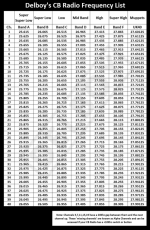
38-LSB busiest, followed by 28 & 20.
These are the hobbyists looking for the greatest number of contacts.

Other activity on LSB are those who’ve shifted from one of those hailing channels by a few channels up or down.

There can be a correlation with the AM side where operators are staying in contact; sometimes 1 to 2-channels adjacent (from AM-19, for example).

Think, “clusters” near to popular channels so as to more easily return to start point. (One, two, three channel clicks).

“Let’s go to Low Side and down 3” (16-LSB from AM-19). Citing frequency change number is the other. (From 27.185 to 27.155).

USB pretty quiet by comparison.

When Skip is heavy is when one hears more activity across the board as foreign stations are more easily heard.

See ALPHA CHANNEL note on figure below.

https://1.bp.blogspot.com/-mnv02HXyLrU/XqlsTqw6ezI/AAAAAAAAEdo/mNHkSGPnRlwlzVZEfLACqU2X4KiDeBSywCLcBGAsYHQ/s1600/CB+Freqencies+Black+And+White.jpg
1719220641894.png

Scanning the CB Freqs is going to be most satisfying with a modern (post-2022 release) radio equipped with a DSP filter (called NRC).
This maximizes Signal Capture in a sense as now the radio can decipher for your ears what before this it could not.

A Scanner just won’t have the RX capability of a dedicated unit.

Freeband is that which is a subject to itself, but which a radio as depicted below is capable.

It’s easy to Scan either via Squelch Break or by Time (x-seconds per channel) and one can do this in any Mode.

IMG_5052.jpeg

“Mode” is really the OP question.

.
 
Last edited:

slowmover

Active Member
Joined
Aug 4, 2020
Messages
4,499
Reaction score
4,519
Location
Fort Worth
Here’s the radio above in action.

— Although on AM, is your scanner remotely close in clarity? This video is pretty much the best online demonstration of this new-found audio high fidelity (given all else in systems was done well as it is here).


The sheer popularity — ubiquity — of Citizen Band argues heavily for acquisition of a NRC scanning unit. These new radios have deeply impressive performance and are rock solid stable on SSB.

At the home station or on the road with a well-sorted antenna system one is in company of many, many users.

What CB was a couple of years ago and what it is now is different due to this tech jump.

Integrated DSP is the felt experience of Revolution jumping past mere Evolution.

.
 
Last edited:

niceguy71

Active Member
Joined
Apr 28, 2023
Messages
1,450
Reaction score
1,965
Location
Massachusetts
38-LSB busiest, followed by 28 & 20.
These are the hobbyists looking for the greatest number of contacts.

Other activity on LSB are those who’ve shifted from one of those hailing channels by a few channels up or down.

There can be a correlation with the AM side where operators are staying in contact; sometimes 1 to 2-channels adjacent (from AM-19, for example).

Think, “clusters” near to popular channels so as to more easily return to start point. (One, two, three channel clicks).

“Let’s go to Low Side and down 3” (16-LSB from AM-19). Citing frequency change number is the other. (From 27.185 to 27.155).

USB pretty quiet by comparison.

When Skip is heavy is when one hears more activity across the board as foreign stations are more easily heard.

See ALPHA CHANNEL note on figure below.

https://1.bp.blogspot.com/-mnv02HXyLrU/XqlsTqw6ezI/AAAAAAAAEdo/mNHkSGPnRlwlzVZEfLACqU2X4KiDeBSywCLcBGAsYHQ/s1600/CB+Freqencies+Black+And+White.jpg
View attachment 164622

Scanning the CB Freqs is going to be most satisfying with a modern (post-2022 release) radio equipped with a DSP filter (called NRC).
This maximizes Signal Capture in a sense as now the radio can decipher for your ears what before this it could not.

A Scanner just won’t have the RX capability of a dedicated unit.

Freeband is that which is a subject to itself, but which a radio as depicted below is capable.

It’s easy to Scan either via Squelch Break or by Time (x-seconds per channel) and one can do this in any Mode.

View attachment 164623

“Mode” is really the OP question.

.
Great bunch of info.... I have never tried 16 20 or 28 LSB I just didn't think anyone used LSB other than 35 to 40.... I have never used my USB or FM on the Quad 5....,. I've tried FM on the President Grant several times in the 90's but never heard a sole
 

slowmover

Active Member
Joined
Aug 4, 2020
Messages
4,499
Reaction score
4,519
Location
Fort Worth
Great bunch of info.... I have never tried 16 20 or 28 LSB I just didn't think anyone used LSB other than 35 to 40.... I have never used my USB or FM on the Quad 5....,. I've tried FM on the President Grant several times in the 90's but never heard a sole

Generally,
Start on 38-LSB to find out if things are going to be busy across Sideband.

Another vid of SSB to accompany your AM one (above) would be great as an addition to this thread if you are so inclined. A demo of SQ break versus Time, etc. How adjusting SQ & RF-G changes Capture. Whatever comes to mind for you.

Imagine being one who doesn’t intend to connect the microphone. For whom CB is a new world.

With the July 4th weekend oncoming, if conditions are good for Skip we can expect heavy use.


The AM vid has been closest to my experience in using the Q5/QT60 in over 1,500-hrs last year.

In the vid one could dial back RF-G and still capture most of that, but more “quietly”.

The Q5 + DRX-901 Speaker combo is revelatory.

For the new user for whom Scan is a favored pastime, take note. This speaker outshines all other external types at the $65-level and below.

Worthy station addition in vocal reproduction.

IMG_3111.jpeg


.
 
Last edited:

merlin

Active Member
Joined
Jul 3, 2003
Messages
3,979
Reaction score
1,888
Location
DN32su
With an AM/SSB radio, best you use one of the 40 channels. When you hear an SSB transmission, it will sound garbled and the signal will
go up with audio. Switch to SSB and adjust the clarifier until you hear normal voice. Most CBers use lower sideband but can be upper.
So you know, frequencies below 26.965 are reserved for military in the US.
There are those that go above the band, like 27.505 which is used in some countries like Australia and Argentina.
 

slowmover

Active Member
Joined
Aug 4, 2020
Messages
4,499
Reaction score
4,519
Location
Fort Worth
So that you know, the frequencies below 26.965 are reserved for the military in the US.

Yeah, if it’s too quiet don’t key up, but be sure radio settings are correct (Band Selection).

Big Brother is one thing. Having The Eye of Sauron turned on you might be quite another.

No mic connected = Best Margin.

Having a sample of one or more who can hear me has been my way of setting up the radio controls to listen to Scan (infrequent). I may only be interested in what’s local thus may ask for an air check.

Band correct?

.
 
Last edited:

N1EXA

FT8 Huntin Mudd Duck on the deep end of the pond !
Joined
Mar 3, 2022
Messages
324
Reaction score
320
Location
Acushnet Heights New Bedford MA - GRID FN41 mp
so your saying SSB is more like a PL or DPL code .. a freq inside a freq rather then a lower or higher freq
sideband.gif


Its the upper side and the lower side of the orignal AM carrier its not a seperate channel.

You will need a radio that can recieve and transmit on these upper and lower sides of the Carrier.

Pete N1EXA
 

FCVPI99

Member
Joined
Nov 4, 2005
Messages
592
Reaction score
94
Location
Rockford,IL
sideband.gif


Its the upper side and the lower side of the orignal AM carrier its not a seperate channel.

You will need a radio that can recieve and transmit on these upper and lower sides of the Carrier.

Pete N1EXA
so your saying SSB is more like a PL or DPL code .. a freq inside a freq rather then a lower or higher freq
 

N1EXA

FT8 Huntin Mudd Duck on the deep end of the pond !
Joined
Mar 3, 2022
Messages
324
Reaction score
320
Location
Acushnet Heights New Bedford MA - GRID FN41 mp
so your saying SSB is more like a PL or DPL code .. a freq inside a freq rather then a lower or higher freq
No PL means Private line - The Radio generates a low frequency hum on the Carrier - The receiver picks up this low frequncy hum and gives you permission to use the frequency ( A Repeater ) as an example. - PL and Digital PL is a Key to Open the system up.

A PL would not be used on SSB modes .

read this to understand


Pete N1EXA
 
Last edited:

N1EXA

FT8 Huntin Mudd Duck on the deep end of the pond !
Joined
Mar 3, 2022
Messages
324
Reaction score
320
Location
Acushnet Heights New Bedford MA - GRID FN41 mp
You have audio frequency that’s from the microphone and the pl is a tone generator and the transmitter generates RF frequencies that goes to the antenna.

Audio Is A combination of frequencies which would be your voice and the pl.

The transmitter generates an rf frequency in the mhz range that frequency has a carrier which also has an upper and lower side band which has a little higher and lower rf frequency.
 
Last edited:
Status
Not open for further replies.
Top