Yes, we did some testing, probably need to do more testing, and had a great time. The test setup was K6GBWs vehicle as the transmit site with a modified NMO mag mount with magnetic coupling capacitor and RF choke in the feedline. Transmit radio was an Anytone 5555N II with an AC power supply to provide consistent power, then transmitter into a 6dB attenuator to provide a constant match then coax to the NMO mag mount. Antennas tested were an older Larsen NMO27 with ribbed base coil and a late model Laird CW27 broad band.
Receive site was my truck about 50yds away with Laird (Antenex) CW27 as the receive antenna (cuz I got so many) into an HP/Agilent 8562A spectrum analyzer initially then vehicle power problems forced me to use a TinySA Ultra spectrum analyzer. In both cases a peak search with cursor was used to find maximum signal level from the transmit site.
Receive site signal to noise ratio was huge, on the order of 50dB or more. The goal was to test receive levels with each antenna from the transmit site then repeat testing to prove the results are repeatable. The results with HP spectrum analyzer were not due to power problems leaving the TinySA Ultra as the only test instrument. A frequency of 27.200MHz was used for all testing being roughly in the middle of the CB band.
With that here are received signal levels from the TinySA first round:
Larsen NMO27 -9.9dBm
Laird CW27 -7.9dBm
Difference = 2dB with Laird showing more gain.
Round two:
Larsen NMO27 -9.8dBm
Laird CW27 -7.8dBm
Difference = 2dB with Laird showing more gain.
I then tested the TinySA Ultra with an HP8920 service monitor generating a signal in the -9dBm range similar to the antenna test setup then varying it a few dB to see if the TinySA tracks and it appears the TinySA level can toggle up to .5dB randomly but only in one direction, so the results can be skewed down by at least .5dB. Each measurement can be very close or off by at least -.5dB. I really wish the big spectrum analyzer did not have power problems as its much more accurate.
Next we measured the VSWR of each antenna using an Anritsu MT8212B Site Master calibrated with short, open and load on the spot from 25 to 32MHz to cover the potential range of the CW27 antenna. Here are plots from both antennas.
CW27 with cursers at 2:1 points, or as close as I could get them. 2:1 points are 26.6MHz at the low end to 31.6MHz at the high end for 5.0MHz BW.

CW27 best VSWR frequencies are 27.2MHz and 30.8MHz.
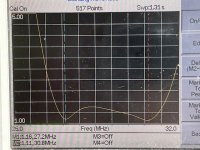
CW27 worst frequency between band edges (red cursor) 28.3MHz @ 1.61VWSR.
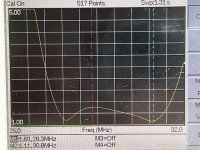
Larsen NMO27 2:1 limits for this antenna on this mount on this vehicle 26.0MHz low end, 27.2Mhz high end for 1.2MHz BW.
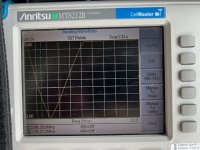
NMO27 best VSWR on this vehicle, this mount, 1.05:1 at 26.6MHz
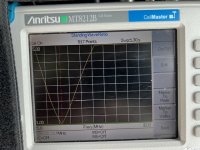
As you can see the Larsen NMO27 was tuned on another vehicle and VSWR changed quite a bit on our test vehicle. We didn't notice this until very late in testing after lots of time spent reminiscing, telling stories, discussing the worlds problems, etc. You know, the important suff. And it was lunch time, so we didn't retune the antenna or retest at the Larsen's tuned frequency. Sorry.
What this means is, I am not certain how much degradation there is/was on the Larsen NMO27 due to being about 2.0:1 VSWR at our test frequency. It may be nothing or it may be some, but I don't think its a lot or even close to the 2dB difference we measured in gain between antennas. We won't know until its tested again and I don't plan on that this week or any time soon. Unless one of us wants to drive in LA traffic for hours to do this all over.
In conclusion we learned a lot about each antenna and I believe the Laird CW27 is a fairly efficient antenna and coupled with its 67.5" length has more gain than a Larsen NMO27 with its 52.5" height and the longer antenna wins. Not to mention the thick and delicious wide band width of the Laird CW27, that thing covers from below CB ch1 into the lower VHF low commercial/military band and everything in between.
Many, many thanks to K6GBW for making the trip to my location and supplying the test vehicle and Larsen antenna!


