Scanner Tales: Radio Shack Stuffage

Stuffage (noun): materials and items related to a specific general topic.

Radio Shack (RadioShack, The Shack, You have questions, we have cell phones et al) is basically gone these days. Yeah, they still have an online presence, and some dealers still have some Radio Shack signs and products but the place we grew up with is dead and buried.

Many of us old-timers remember fondly walking or riding our bikes to the local Radio Shack (It was two words back then) to look at the latest scanners, CB’s and (later in our lives) stereos for our bedrooms, cars and dorms. They weren’t the best by far, but they were affordable and, more importantly, every town over 35 people had at least one Radio Shack store or dealer.

Store or Dealer? Well, if you were in a small town, you may have had had a “Radio Shack Dealer” rather than a dedicated Radio Shack Store. “Dealers” were independent businesses, mostly hardware stores, dime stores or appliance shops, that sold Radio Shack products. They would not have the entire line, only what they thought would sell in their market. “Stores” were company owned and sold the entire line. When I was a kid we spent a lot of time at a relative’s farm in central Illinois, there was a Radio Shack Dealer in a hardware store in the next town over that we would ride our bikes or horses to along an old railroad right-of-way that had been abandoned. It was right next to an old-fashioned ice cream parlor, complete with a soda fountain that even in the 60’s looked nostalgic.

While we have often talked about our favorite and least favorite Radio Shack scanners, they always seemed to have the accessories we needed. Need an antenna for the car, got it. Need a power cable for that old scanner, got that too. Need batteries for your cattle prod to herd your cats? Yep, got those as well. This is the kind of thing that we in the Midwest called “Stuffage”. It’s not the glittery products that adorn the cover of the catalog or front of the store but the nitty-gritty product at the back of the store that we kids could afford to buy with our allowance and lawn-mowing money.

Radio Shack had a few quirks that made it unique. For us, the “Battery of the Month” card was awesome. I had a few stores in bicycle range, so I had cards for each store. I also would watch for a different employee to be working so I could use an additional card. This way I could get up to a dozen batteries each month when the stars aligned, and my mom would drive me to the mall (which had 2 Radio Shack’s in it!).

Another quirk that became important to me when I got older was that Radio Shack was one of the last stores that allowed smoking inside of it. They even had free-standing ashtrays shaped like an EnerCell battery.

Every time you bought anything at Radio Shack, they would fill out a 2-part receipt and get your name and address on it, they would keep the white (top) copy and give you the yellow (carbon) copy. They had signs posted that advised “Why we ask for your name and address”, it was for their mailing lists so they could send you the catalog. I would often give the name of my dog with my neighbor’s address just to mess with the guy. My neighbor would get confused however when catalogs would show up in their mail addressed to my dog and not theirs.

There were several Radio Shack products that we would buy over and over. One was the famous 20-176 scanner antenna. This was a basic VHF quarter-wave ground-plane that had a couple of UHF spikes. It was a great antenna for $9.95 (in the 70’s) and retained its value when it went up to $14.95 and later $19.95 by the time Radio Shack bit the dust. It worked great for all scanner bands except low-band and worked well as a dual-band ham radio antenna (2-meter and 440) while maintaining a low profile. I bought many of these over the years and would usually put up 2 when I could sneak onto the roof of my condo or apartment. I have one still in the attic of my home now and it works fine.

Of course, Radio Shack had other scanner antennas, they even owned the company that made them, sort of. AntennaCraft, of Burlington Iowa, made most of the base station TV and Scanner antennas for Radio Shack and also sold them under their own brand. I have 4 of these and could sell them for a whole lot more than the $5 each I paid when they were closed out years ago. Sometimes Radio Shack would have the AntennaCraft branded antennas in the stores, I presume this was an error in shipping.

AntennaCraft was owned by the same holding company as Radio Shack, as were several other manufacturers over the decades. While their primary business was TV antennas and related accessories their scanner antennas were well regarded.

The “ST-x” series were well known and in particular the ST-2 is revered in the scanner hobby. These were sold by several retailers like Grove Enterprises and Scanner Master but were identical to the ones sold by and as Radio Shack.

They made the ST-1, an off-center fed vertical dipole, the revered ST-2, a center-fed dipole with multiple elements, the ST-3, which we all know as the famous 20-176 mentioned above and the ST-4, a discone. Radio Shack sold each of these at one time or another but did not use names or model numbers, just the catalog number.

As for the ST-2 there have been a couple attempts at recreating it. One RadioReference member went so far as to actually make a replica based on the original design but with better materials. That project seems to have gone away but it did show some real promise. I tried to convince Scanner Master to have one built but after a cost analysis it was determined that the potential sales would not be enough to pay for the tooling and design costs. ChannelMaster also made an almost identical antenna called the “Monitenna”, Model 5094A.

One could also buy mobile scanner antennas at Radio Shack. They sold a couple different mag-mount scanner antennas over the years. While I was more into NMO and trunk-lip mounts for my vehicles I did have a few of these and they worked just fine. My favorite was the one with 2 covered loading coils, it worked quite well on all bands, even low-band.

Radio Shack had all kinds of coax as well. They sold RG-58, RG-59 and RG-8 in precut 25-, 50- and 100-foot lengths with PL259’s. They even had bulk coax in some stores so you could buy the length you needed. Radio Shack owned the manufacturer of their coax as well. They had all kinds of connectors and adapters.

Need a tri-pod mount for the roof? How about a 5-foot mast? Twin-Lead? Radio Shack had all this stuff. While most of it was geared towards TV antennas, much of it worked just fine on scanner antennas. Remember that the various scanner and TV bands are intertwined, the big difference is that TV is horizontally polarized while two-way radio is mostly vertical. Take a TV antenna and flip it on its side and you have a great (albeit very directional) scanner antenna. All those TV antenna accessories worked great for your scanner antenna.

Of course, Radio Shack sold scanners, they probably outsold all the rest of the companies’ combined due to the many hundreds of stores all over the US. They had a wide variety of handheld and desktop scanners over the years. While they may not always have been the best or feature-filled scanners around, the build quality was always better than average. Older Bearcat and Regency scanners were well known for cold solder joints, flaky power supplies and other issues that were pretty much absent on Radio Shack scanners back in the day. Look to other Scanner Tales for a more in-depth look at these.

Other than scanners, crystals and scanner accessories Radio Shack sold a few ham radios now and then. While the company started as a supplier for ham and maritime radio operators it pivoted away towards more commercial product lines but would occasionally come home to roost. In later years they sold some basic 2-Meter handhelds and 10-Meter mobiles. These were similar to their marine and CB lines respectively. I am pretty sure that some of the 2-meter products were built by Icom or perhaps the same supplier as Icom as they used similar cases and batteries.

I almost forgot to mention the crystals! Every Radio Shack sold scanner and CB crystals. They would usually have a decent selection for the local police and fire channels, and you could order any others you wanted. $4.95 each, plus tax with free shipping to your home. If the manager at your local Radio Shack was a scanner guy he would have a better selection, the guy who ran the store in my town loved to watch the Soo Line trains go past his store, so he always had crystals for 161.370 and later 161.085 available.

Over the years I think everyone had some sort of Radio Shack stereo gear. While I was pretty much a Kenwood guy in my apartment (my stereo cost more than all my furniture) I usually had a Radio Shack speaker system, tape deck or something. Radio Shack sold one of the few 8-track recording decks around. My Dad, who stuck by 8-tracks much longer than anyone else on the planet, had 2 so he could copy one to another for use in his car. I had one as well but gave up on 8-track after cassettes got popular. Radio Shack sold blank 8-track tapes to go along with the recorder and Dad and I had dozens of them.

I did have a Radio Shack stereo in the car. My typical installation was an AM/FM with tape deck (8-Track then cassette) with 5-inch round speakers in the door and 6x9’s in the rear package shelf. I also would put an outboard power amplifier and graphic equalizer to keep the neighbors up at night.

One thing I wished I still had was the Minimus-7 speakers. These were durable, metal cased and small but packed a punch. I had 4 of these in the apartment but when I was able to afford larger and louder speakers, I started to use these on my scanners. They worked great! If you run across these at a thrift shop grab them!

Another staple of 70’s and 80’s stereo installations was the Graphic Equalizer. I had no idea what it did or why I needed it, but I had to have one on both my home and car stereo systems. It was just too cool to have a couple dozen slide controls to tailor the sound. I usually just played with the sliders until it sounded good but really had no clue why that setting worked. Even better was the flashing lights that changed with the music.

Back to scanner stuff (I know I have been bouncing around a lot…)! Of course, we know all about Police Call and how they were sold at Radio Shack. They even had the Radio Shack name on them. Most decent Radio Shack stores had their own frequency lists, often posted near the scanners. I would often program the scanners in mall stores with the security channel for that mall, I even got yelled once at by a wannabe Paul Blart since he was right behind me when I did. He tried the “It is illegal to listen to” spiel on me but I told him to prove it. While he could have kicked me out of the mall (once I left Radio Shack that is) he figured it wouldn’t be worth the effort.

Many of us had Navaho CB radios, I always wanted one of those base station rigs but made do with mobiles on a power supply. They used to sell a “Space Patrol” base CB that had a single crystal controlled transmit channel (usually Channel 14) and a tunable receiver. It would transmit at the 1/10 watt allowed for license free operations at the time. We all had these in our neighborhood and some of use rigged up a crystal socket on the top of the radio so we could easily change to a different channel. The trick was to get the receive channel tuned in properly. We even tried some split-channel stuff when Tom would transmit on Channel 7 and listen on 14 and I would do just the opposite. My Dad was not too happy when I connected this radio to our TV antenna, every time I would talk it would mess with the picture while he was watching “Bonanza” or “Lawrence Welk”.

CB radio started getting really popular in the late 60’s, by the mid 70’s everyone had CB’s in their car and many of us had them at home. I had the most basic 23-channel radio, the famous TRC24 and a 5/8 wave antenna on the roof of the house. I cut grass all summer long to buy that setup, even in 1970 it cost something like $250 with all the parts and an entire Saturday for Dad and I to install the antenna. Dad had a small 6-channel Radio Shack CB in the family station wagon. I had a 6-channel Midland CB walkie-talkie that I used on my bike.

In 1977 the FCC expanded CB to 40 channels, and I remember going to Radio Shack on New Years Eve to get any remaining 23-channel radios they had since they could not sell them in the new year. I was able to get 3 23-channel CB’s at one store for $10 each and 4 more for $15 each in the next town. I kept the best one (with SSB!) for my car and sold the rest from time to time for a profit.

During the 2000’s Radio Shack hit a rough patch and after several bad business decisions and a changing business climate they started the slow death rattle. Eventually it all but disappeared, much like CompUSA, Bed Bath and Beyond, Circuit City and others. While one can get just about anything online these days the ability to drive into town and get a resistor or antenna was gone and sorely missed by many.
 

ladn

Explorer of the Frequency Spectrum
Premium Subscriber
Joined
Oct 25, 2008
Messages
1,775
Reaction score
2,098
Location
Southern California and sometimes Owens Valley
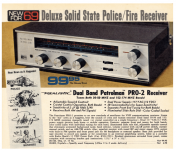
I remember the era of "scanners," which weren't scanners at all. Radio Shack made tunable receivers. When they were tuned, they received about half a megahertz so you always fought the terrible noise of several competing frequencies being received at the same time.
My first "scanner" was one of those circa 1970! It was tunable, VHF HI/LOW. Like @es93546 said, accurate tuning wasn't possible, but it worked fairly well for that time period where agencies had fewer frequencies and 30 KHz bandwidth channels.

1726669646241.png
 

es93546

A Member Twice
Premium Subscriber
Joined
Aug 18, 2020
Messages
1,710
Reaction score
1,165
Location
Right Side of CA on maps
My first "scanner" was one of those circa 1970! It was tunable, VHF HI/LOW. Like @es93546 said, accurate tuning wasn't possible, but it worked fairly well for that time period where agencies had fewer frequencies and 30 KHz bandwidth channels.

View attachment 169457

My memory of these things was correct! In the L.A. Basin there were so many frequencies that were active that a tunable receiver still had a lot of noise. I could not afford the $100 price tag on these, so I dealt with the handheld version. I noted that when the Regency crystal scanners came out the price was $100 also. I didn't know much about radio then, I should have waited and gotten the Regency VHF High and Low version. I wish those would have had more than 8 frequencies.

I started out being a law enforcement fan, but once I left L.A. and got a firefighting job with the USFS, I became a fire and natural resource agency fan. The Regency only had a 5 MHz receiving width. To get the USFS I had to take my radio to our (the National Forest I worked on) radio tech to retune the peak to about 170 MHz. I was still able to get the PD and FD in Flagstaff, but I was able to pick up the Kaibab, Coconino and Prescott National Forests. All operated on simplex with one or more remote bases scattered around. I was able to pick up most lookouts on those forests and they were often employed as "human repeaters." They would relay the traffic from a unit that wasn't able to hit the remote base.

My first wife did not like "the monitor" as she called it. That until the Radio Fire of 1977 burned intensely right next to Flagstaff where we lived. The day it started I got home from work to find about 5-6 neighbors on our porch listening to the scanner in the living room. So much for the useless "monitor." Unfortunately that relationship ended in divorce, but 7 years later I married my second wife. Boy, what a difference! We've now been married over 30 years. She turns the scanner on in the morning before I do. She is really into it. That interest started when both of us became members of our town's CERT organization sponsored by the PD. We made a lot of friends with members of that department, so we like to keep track of what they face.
 
Last edited:

es93546

A Member Twice
Premium Subscriber
Joined
Aug 18, 2020
Messages
1,710
Reaction score
1,165
Location
Right Side of CA on maps
So how many of you had a piece of masking tape along the dial on these old tunable receivers with pen marks for your favorite channels?

I knew a guy who used different color tape cut real narrow and he put it directly on the tuning screen. Yellow meant this P.D. and green another and so on. I don't miss those days. I really got into it when I bought my first programmable scanner in 1978. They had been out since 1976 or earlier, but I didn't have the money at the time. We moved to another state and it would have cost $40 to update the crystals in the Regency, so I didn't do that. I waited until I had the bucks for a BC-210. Shortly after I bought it the BC-220 came out. It had 20 channels and was air band capable. I used the 210 for about 5 years before replacing it with another Uniden scanner.
 

N6JPA

A Ham Radio Operator With too much frequency.
Joined
Oct 21, 2018
Messages
165
Reaction score
129
Location
San Luis Obispo, CA
Back in the 1970's when I was a snot nosed kid I would ride my bicycle to the nearby RS store. At first the manager thought I was just a bother, but I had a paper route and was soon buying SWL Radios, Scanners and CB's with my money. I purchased radios from RS until about 2005, but then everything went online. Don't forget if you got a battery card when you bought batteries(AA for my portable scanner) you could earn free batteries.
 

Falcon9h

Member
Premium Subscriber
Joined
Jan 31, 2020
Messages
493
Reaction score
459
I remember the era of "scanners," which weren't scanners at all. Radio Shack made tunable receivers. When they were tuned, they received about half a megahertz so you always fought the terrible noise of several competing frequencies being received at the same time. You really could not tell exactly where you were tuning, so once you received what you wanted to hear you left it there. My first receiver from Radio Shack was a handheld that really performed quite badly. Their receivers were sold under the brand 'Patrolman." I bought it in 1968 along with my trusty Police Call. There were larger desktop receivers that tuned in a smaller spread. I could not afford one of those. A neighbor of mine had a friend that mounted 2-3 of these things under the dashboard of his vehicle with 1-2 of them mounted to racks on the center hump of his vehicle. He had small. very narrow, strips of tape on the display that made it a shorter effort to tune in various frequencies. While he had less of the "receiver wars" it still occurred.

Then in late 1970 I bought a Regency TMR-8 VHF High crystal scanner. It only had only 8 channels. There was so much I was missing with such a limited number of frequencies on just one band. I still have every crystal I ever bought and of course the radio with the flashing red lights. I don't remember where I bought it.

I remember that if I had a technical question I went to Henry Radio in west L.A. I think it was on Olympic Blvd. just west of the 405 freeway. They helped me a bit with a very cheap receiver that had some of the HF spectrum. They helped me design and build a dipole that went from one of our house's lot boundary back to the house. It must have been at least 60 feet long. I spent all kinds of time tuning in weak frequencies and eventually was able to receive "Radio Hanoi." This in 1968, with the war in Vietnam at its height. The thrill of DXing caught me right then and there. Henry Radio was fully staffed with expert "Ellmers" behind the counter.

I bought a few things at Radio Shack because there was on of them about 2 miles from home. But, even then, with little experience, I thought that most of their products were of "marginal quality," to be kind.
I'm with you. I had a couple of the tunable receivers. I'd like to find one now for shts and giggles and to be nostalgic. Build quality of the early scanners was good, not so much for later. I have a pro-97 and I'd be afraid to drop it. It's a good scanner though except fot the tinny audio.
 

Falcon9h

Member
Premium Subscriber
Joined
Jan 31, 2020
Messages
493
Reaction score
459
My first "scanner" was one of those circa 1970! It was tunable, VHF HI/LOW. Like @es93546 said, accurate tuning wasn't possible, but it worked fairly well for that time period where agencies had fewer frequencies and 30 KHz bandwidth channels.

View attachment 169457
Great looking receiver though! Gonna try to find one.
 

Falcon9h

Member
Premium Subscriber
Joined
Jan 31, 2020
Messages
493
Reaction score
459
My first "scanner" was one of those circa 1970! It was tunable, VHF HI/LOW. Like @es93546 said, accurate tuning wasn't possible, but it worked fairly well for that time period where agencies had fewer frequencies and 30 KHz bandwidth channels.

View attachment 169457
Great looking receiver though! Gonna try to find one.
 

bergamot

Newbie
Joined
Aug 29, 2013
Messages
3
Reaction score
3
My high school/tech school part time job was at a Radio Shack in the Chicago suburbs in the late 1970’s so here are some random memories. Since I was a ham going for an electronics degree, I sometimes did simple customer repairs in the back room for faster turnaround time than the company repair center. The 12V power supplies were the easiest because it was usually fixed by replacing the transformer (blown fusible link). Although some products were poor quality, stereo receivers, scanners, clock radios, antennas & CB’s were good values. Keeping electronics components fully in stock was impossible because they would often zero out many of our orders. At least once a day, I went out to the parking lot to measure swr for a Cber, a service they really appreciated. Many times I had to debunk the myth that cutting your coax to a certain length lowered your swr.

One day I was showing an expensive speaker system to a customer & to my amazement, he cranked the volume, lit a match & held it in front of the woofer. The sound waves blew the match out & he immediately agreed to buy them. Another time, a regular customer came in accompanied by a man with long hair who he called Bud. I sold Bud some wireless intercoms plus other items & when he handed me his credit card, it said “Marlon Brando”. Somehow at that young age, I realized all he wanted to do was walk into a store & be treated normally like anyone else. So with no drama I said it was a pleasure to meet him, shook his hand & rang up the sale. It made sense he visited the store since he lived in the area as a teenager & occasionally returned to visit friends & relatives.

The free battery card was brilliant marketing. Many customers getting the freebie often purchased something during the visit & the markup on batteries was so high, Tandy didn’t lose much giving them away. It baffles me why we sold so many color organs when it was such a cheesy product. Maybe it was like early video games, which were also lame, but it’s all we had.
 

a727469

Active Member
Joined
Jul 15, 2003
Messages
693
Reaction score
557
Location
Maine
It would be hard to find service like you provided at RS in many stores today. I too got a few free batteries🔋
 

IC-R20

LoBand Nation
Joined
Nov 19, 2018
Messages
744
Reaction score
496
So how many of you had a piece of masking tape along the dial on these old tunable receivers with pen marks for your favorite channels?
I still do that now with camera lenses to mark focus points to move between. It's nice when different hobbies translate together like that.
 

dlwtrunked

Member
Premium Subscriber
Joined
Dec 19, 2002
Messages
2,805
Reaction score
1,673
For every place I lived, I have very place I lived, I had a Radio Shack story. In Ohio, while in high school saving my lunch money 50 cents/day for RS, I went to RS just before closing and rushing in, left my keys in the car and locked myself out. I was detained by the police for trying to break into my car using a hanger through a partially down window to try to unlock the car door. In Pennsylvania, I remember a lady asking the RS employee if the VHF or UHF TV antenna should go on top. He replied the UHF antenna should go on the bottom as have a shorter wavelength and therefore could not reach as high above the ground; I loudly laughed and never felt welcome in that store after that. In Connecticut, I remember the manager telling me a long story of his out-of-body near-death experience when he "died" from smoke inhalation in a house fire. In Virginia, I had one store manager tell me RS did not wish to hire technical knowledgeable people as the sold fewer not needed items to other customers. Another manager had me answer phones in the store when I came in to buy something when they were busy with other customers. He told me that was because I knew more about what they were selling than he did. Later I had to ask him to quit giving my phone number to other customers when he could not answer a question.
 

IC-R20

LoBand Nation
Joined
Nov 19, 2018
Messages
744
Reaction score
496
For every place I lived, I have very place I lived, I had a Radio Shack story. In Ohio, while in high school saving my lunch money 50 cents/day for RS, I went to RS just before closing and rushing in, left my keys in the car and locked myself out. I was detained by the police for trying to break into my car using a hanger through a partially down window to try to unlock the car door. In Pennsylvania, I remember a lady asking the RS employee if the VHF or UHF TV antenna should go on top. He replied the UHF antenna should go on the bottom as have a shorter wavelength and therefore could not reach as high above the ground; I loudly laughed and never felt welcome in that store after that. In Connecticut, I remember the manager telling me a long story of his out-of-body near-death experience when he "died" from smoke inhalation in a house fire. In Virginia, I had one store manager tell me RS did not wish to hire technical knowledgeable people as the sold fewer not needed items to other customers. Another manager had me answer phones in the store when I came in to buy something when they were busy with other customers. He told me that was because I knew more about what they were selling than he did. Later I had to ask him to quit giving my phone number to other customers when he could not answer a question.
I still remember the crappy scanner lists they got from bearcat1. That said I was surprised any of them could even figure out how to work a scanner let alone program it for anyone.
 

FedFyrGuy

Member
Premium Subscriber
Joined
Dec 26, 2004
Messages
228
Reaction score
94
Location
Hagerstown, Maryland
Used to stop into the Radio Shack Distribution Center at 100 Tandy Dr in Hagerstown, MD from time to time. They had a "Warehouse Clearance Store" in the front of the building. Occasionally some good buys there. The building was sold in 2015 for $11.4M as part of the company liquidation.
 

N9JIG

Sheriff
Moderator
Joined
Dec 14, 2001
Messages
6,589
Reaction score
6,161
Location
Far NW Valley
Used to stop into the Radio Shack Distribution Center at 100 Tandy Dr in Hagerstown, MD from time to time. They had a "Warehouse Clearance Store" in the front of the building. Occasionally some good buys there. The building was sold in 2015 for $11.4M as part of the company liquidation.
One of the RadioShack stores near my hometown seemed to be the regional clearance place, they always had open-box and returned stuff on a table at the rear of the store. It had been some other type store before it's Radio Shack days so was larger than the normal store, probably why they sent the stuff there to get rid of it.
 

jmp883

Member
Premium Subscriber
Joined
Jan 7, 2005
Messages
606
Reaction score
124
Location
Northern NJ
Some great memories being posted here about Radio Shack. I, too, miss Radio Shack. My introduction to Radio Shack wasn't for the scanners, crystals, or parts, it was for their stereo equipment. I had an uncle who turned me on to component stereo systems in the 1970's. He had all high-end Japanese equipment, something I wouldn't be able to afford for years. My first system consisted of an STA-850 receiver (which I still have), a LAB-440 turntable, and a SCT-24 cassette deck. The only non-RS equipment was the ADC Sound Shaper equalizer and the BSR 3-way speakers. That system lasted for years, even after I started buying 'real' components. I was also a fan of their car stereos. Eventually I started buying their scanners, I can't even remember all the different RS models I've had over the years.

It was a great store, just as much fun as my local Harley dealership or my local model railroad hobby shop!
 

JDKelley

Just call me "Sparks." Or "Lucky."
Premium Subscriber
Joined
Aug 31, 2019
Messages
376
Reaction score
264
Location
Hammerspace
This brings back memories!

When I was a kid, I had two electronics suppliers - Radio Shack, and CWY. Radio Shack was for all the "common" stuff, and CWY had a full line of NTE and vacuum tubes (I was the go-to guy for fixing tube amps and suchlike. I didn't have a shop, but everyone brought their tube-driven stuff to me. And my stereo amp? Old Seeburg jukebox tube amp. My stereo was pieced together from whatever felt right, and I could play damned near anything except Edison wax cylinders. Four-speed turntable, 8-track, 1/4" reel-to-reel, double-cassette deck, one of the early Philips/Magnavox CD players (they invented the thing,) Betamax video player, VHS video player - I didn't bother with LASERDisc, but I did have two of my three computers connected where I could switch them to the stereo, just for fun. Anyhow.)

Both were within bicycle range (two Radio Shacks!) - but then, so was the rest of the Northern half of the state, to me. It would have taken me a bit, but I could probably have ridden the 300 miles to Chicago (but taking my sailcar was much more fun!) I was a fixture in both of them, I was always working on something. I bought every Forrest Mims book that Radio Shack had, which is how I learned electronics. I got hold of a circuit in one of those books, worked with it, expanded it the way he said, then I had to buy 900 red LEDs [EDIT - 30x30 matrix] and enough perfboard to mount them on, and etched a circuit board for the control electronics, and built myself an oscilloscope. It was funny when I walked up to the counter and asked for a thousand red LEDs, tho. Spent a half-hour convincing them that I was serious, and explaining what I wanted to do with them. Then I had to promise to take the project in to show them (making a case for it was a royal pain, since I had to drill all those holes by hand. Didn't have machines hop classes available yet, so I had to lay it all out by hand, pilot the holes, then drill them out, and use a countersink to clean up the outside of the hole - all with a hand drill! (From CWY, I bult a VTVM.)

Radio Shack scanners were great - while I was following them, I think the PRO-2006 is the pinnacle of their development. It's plenty capable on their own, but there's room for the tinkerer to modify and improve it (and our dear Dr. Rigormortis - Bill Cheek - gave us manuals to do so (and plenty of very interesting mods. I've built two of the 6,400-channel mods. I've cut the "cellular lockout" diodes where I can, but I've also got a Russian Malahit DSP-3 that doesn't even bother blocking those frequencies out.) They were great for a quick place for common discrete components or integrated circuits - as long as you don't need anything exotic. And they kept mall hours (CWY kept banker's hours, which fact I find irritating. I've always been nocturnal.)

The "Battery of the Month" card was also nice - I had four, and I'd figured out the schedules for the managers and assistant managers at each store, so I could get my batteries from each without the other seeing it (I don't know if they talked, and they probably thought it was funny, but I spent at least $50/week there as it was, in the early 80s, so they probably didn't care.)

It was truly sad to see them ditch components and go "in for a pound" on consumer electronics. And around here, Quement has long closed, and Fry's has left, so finding electronic components is a pain (and there's no-one that is open late anymore.)
 
Last edited:
Top