External Tuner

Status
Not open for further replies.

merlin

Active Member
Joined
Jul 3, 2003
Messages
4,014
Reaction score
1,930
Location
DN32su
A 2:1 match or better is generally accepted as almost standard. 3:1 and you are loosing 3/4 of your EIRP.
I don't know how trustworthy the SWR reading on the meter would be, I take it with a grain of salt.
3 sensors in the ATU are forward power, reflected power, and antenna current.
Some internal ATUs have the tuning algorithm in the system brain, some have like a PIC16
the sensors can go out of adjustment and tuning stops before ideal match.
I would look at the antenna with an analyzer so see if it will go to 80 and 160 meters,
it may not.
I have a 33 foot vertical with an Icom AT-140. It will tune 80 and 160 meters nicely but don't get the performance I have with a broad band butterfly.
You don't need lots of power for FT8, even 10 watts is remarkable. If you can get 25 watts, you should do lots of logging.
 

merlin

Active Member
Joined
Jul 3, 2003
Messages
4,014
Reaction score
1,930
Location
DN32su
LOL!!! Yeah, I hear you. It's really hit or miss with them these days it seems. Depends on whether or not QC got a hold of the batch or not. I have gotten pretty lucky, thankfully.

My previous tuner was a LDG1000 Pro II and unfortunately, it only handled 1000W. The worst part was that it only did something like 350W in digital modes. No thanks. I really like their tuners, but if you ever plan on running a decent sized amp, you're going to be rebuying something else.

My 2nd choice (actually my 1st choice at the time) before I went with the MFJ was the Palstar HF-Auto. Was ready to throw down the cash until I used my friend's. Slow as hell with the huge roller inductor, especially when changing bands. Not that I do anything that requires super fast band changes, but it was just annoying to me.
All those tuners with servo rollerductors were badly slow. Relays are not the quickest but the new FET swithches are lightning fast.
 

AK9R

Lead Wiki Manager and almost an Awesome Moderator
Staff member
Super Moderator
Joined
Jul 18, 2004
Messages
11,330
Reaction score
11,282
Location
Central Indiana
What tuner uses that ?
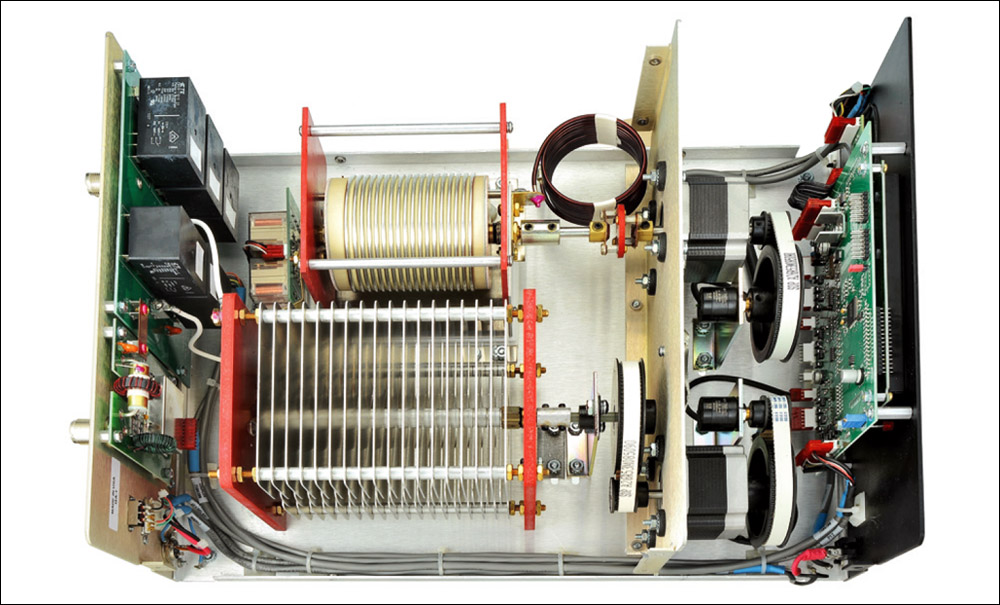
The Palstar HF-Auto is an example of a servo-controlled roller inductor tuner. See photo. The large cylindrical object at the top of the photo is the roller inductor. The larger object with all the plates is the capacitor. Look to the right of both of them and you'll see the belt drives for the servo motors.

hf-auto-lrg-inside.jpg
 

jazzboypro

Active Member
Premium Subscriber
Joined
Aug 7, 2019
Messages
1,076
Reaction score
409
Location
Laval
The Palstar HF-Auto is an example of a servo-controlled roller inductor tuner. See photo. The large cylindrical object at the top of the photo is the roller inductor. The larger object with all the plates is the capacitor. Look to the right of both of them and you'll see the belt drives for the servo motors.

hf-auto-lrg-inside.jpg

I'm sorry i was not clear, i meant what tuners uses the FET Switches
 

merlin

Active Member
Joined
Jul 3, 2003
Messages
4,014
Reaction score
1,930
Location
DN32su
Many of the newer tuners use a power fet switching diode. typically the stand alone smart tuners and under the 250 watt class.
Now you can look up all the schematics and specs for these tuners and note which uses relays or diode switching. sorry, but I just don't have the time for that.
 

merlin

Active Member
Joined
Jul 3, 2003
Messages
4,014
Reaction score
1,930
Location
DN32su
The Palstar HF-Auto is an example of a servo-controlled roller inductor tuner. See photo. The large cylindrical object at the top of the photo is the roller inductor. The larger object with all the plates is the capacitor. Look to the right of both of them and you'll see the belt drives for the servo motors.

hf-auto-lrg-inside.jpg
Still beats the hand crank dials like my Collins transmitter.
 
Status
Not open for further replies.
Top