Question about simulcast

Status
Not open for further replies.

Pr999

Member
Premium Subscriber
Joined
Aug 8, 2021
Messages
417
Reaction score
97
Location
Allegan County, Michigan
There are many ways to phrase this question but... How come p25 scanners of the mid 2000s had no issues with picking up simulcast back then, but have those issues now? What has changed with simulcast? More towers maybe? Give me the history!
 

StoliRaz

£uck Encryption
Premium Subscriber
Joined
Dec 4, 2007
Messages
1,086
Reaction score
994
I don't remember much simulcast back then, any P25 that I knew of was straight P25 conventional

I remember when simulcast just referred to broadcasting the same thing on 2 different frequencies though.
 

GTR8000

NY/NJ Database Guy
Database Admin
Joined
Oct 4, 2007
Messages
17,011
Reaction score
16,451
Location
BEE00
There are many ways to phrase this question but... How come p25 scanners of the mid 2000s had no issues with picking up simulcast back then, but have those issues now? What has changed with simulcast? More towers maybe? Give me the history!
They would've had issues back then also with simulcast P25 trunking, however simulcasting P25 wasn't as prevalent as it is today, so it wasn't complained about as much. Simulcast P25 would've used C4FM modulation early on, not LSM/QPSK, and therefore a bit easier for scanners to deal with. It's the AM component of the LSM/QPSK that give scanners so much trouble today, unless they were designed to properly handle it.

Most conventional P25 simulcast are C4FM, although LSM/QPSK has gained some traction in that realm also, so it's not just simulcast P25 trunking using those modulations anymore.
 

RFI-EMI-GUY

Member
Joined
Dec 22, 2013
Messages
8,355
Reaction score
5,705
Analog simulcast of the Motorola Smartnet 3600 control channel variety was much more forgiving of site spacing and geometry than P25 is. The analog actually sounded better. I have compared both from my QTH in that my county made a conversion some years back.
 

Pr999

Member
Premium Subscriber
Joined
Aug 8, 2021
Messages
417
Reaction score
97
Location
Allegan County, Michigan
They would've had issues back then also with simulcast P25 trunking, however simulcasting P25 wasn't as prevalent as it is today, so it wasn't complained about as much. Simulcast P25 would've used C4FM modulation early on, not LSM/QPSK, and therefore a bit easier for scanners to deal with. It's the AM component of the LSM/QPSK that give scanners so much trouble today, unless they were designed to properly handle it.

Most conventional P25 simulcast are C4FM, although LSM/QPSK has gained some traction in that realm also, so it's not just simulcast P25 trunking using those modulations anymore.
what made them change from C4FM to LSM/QPSK?
 

Ubbe

Member
Joined
Sep 8, 2006
Messages
11,045
Reaction score
4,740
Location
Stockholm, Sweden
In the 70's we had an analog system that had three transmitters on the same frequency. The instruction from the project manager where to have one transmitter -15Hz and the other +15Hz offset. That was supposed to reduce the risk of total cancellation of the radio waves. But that 15Hz are what you easily get in doppler effect when driving so there where always complaints. It was soon replaced by a single high power transmitter in the middle of the area. But total cancellation of radio waves also happens in modern simulcast systems, so they are never 100% interference free by design.

/Ubbe
 

RFI-EMI-GUY

Member
Joined
Dec 22, 2013
Messages
8,355
Reaction score
5,705
what made them change from C4FM to LSM/QPSK?
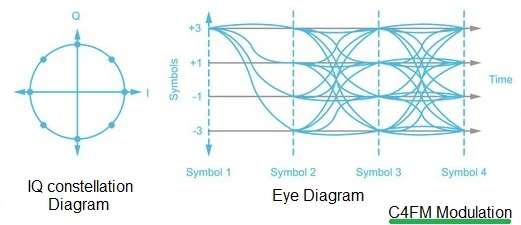
With C4FM the acceptable separation between transmit sites was limited to 1/2 the symbol rate at which point a receiver would be unable to determine a 1 or 0 or 11 or 00 as the modulation was 4 level. This is seen as an eye pattern on an oscilloscope on the detector of the receiver. When two transmitters are far apart in arrival time (about 9 miles) the eye pattern appears closed. This is what a C4FM should appear like at the receiver, (with simulcast interference the "eyes" would blur and close up).
C4FM.jpg

The CQPSK introduces an additional timing reference point for the demodulation , opening the eye pattern larger with that synch and thus the site separation can be doubled. The sharper the eye pattern the more easily the data is decoded.
CQPSK.jpg


Pr999

Member
Premium Subscriber
Joined
Aug 8, 2021
Messages
417
Reaction score
97
Location
Allegan County, Michigan
Follow up question: why is simulcast reception worse with phase II but not with phase I? I think this was answered in another thread with a similar question but I don't remember where.
 
Status
Not open for further replies.
Top