There are many ways to phrase this question but... How come p25 scanners of the mid 2000s had no issues with picking up simulcast back then, but have those issues now? What has changed with simulcast? More towers maybe? Give me the history!
They would've had issues back then also with simulcast P25 trunking, however simulcasting P25 wasn't as prevalent as it is today, so it wasn't complained about as much. Simulcast P25 would've used C4FM modulation early on, not LSM/QPSK, and therefore a bit easier for scanners to deal with. It's the AM component of the LSM/QPSK that give scanners so much trouble today, unless they were designed to properly handle it.There are many ways to phrase this question but... How come p25 scanners of the mid 2000s had no issues with picking up simulcast back then, but have those issues now? What has changed with simulcast? More towers maybe? Give me the history!
what made them change from C4FM to LSM/QPSK?They would've had issues back then also with simulcast P25 trunking, however simulcasting P25 wasn't as prevalent as it is today, so it wasn't complained about as much. Simulcast P25 would've used C4FM modulation early on, not LSM/QPSK, and therefore a bit easier for scanners to deal with. It's the AM component of the LSM/QPSK that give scanners so much trouble today, unless they were designed to properly handle it.
Most conventional P25 simulcast are C4FM, although LSM/QPSK has gained some traction in that realm also, so it's not just simulcast P25 trunking using those modulations anymore.
Advances in technology.what made them change from C4FM to LSM/QPSK?
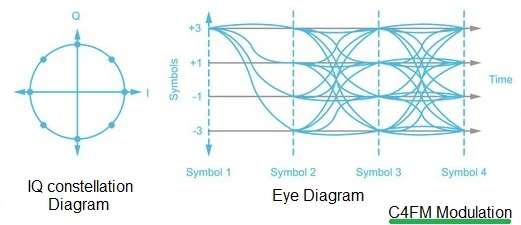
With C4FM the acceptable separation between transmit sites was limited to 1/2 the symbol rate at which point a receiver would be unable to determine a 1 or 0 or 11 or 00 as the modulation was 4 level. This is seen as an eye pattern on an oscilloscope on the detector of the receiver. When two transmitters are far apart in arrival time (about 9 miles) the eye pattern appears closed. This is what a C4FM should appear like at the receiver, (with simulcast interference the "eyes" would blur and close up).what made them change from C4FM to LSM/QPSK?
It's all explained under the "Problem" subsection of the wiki linked belowFollow up question: why is simulcast reception worse with phase II but not with phase I?