ArloG

Member
Joined
Feb 14, 2020
Messages
389
Reaction score
142
- RTL-SDR, RTL-TCP, SoapySDR, TCP/UDP PCM, WAV/file, and M17 UDP input/output paths.

I'll crown you King if you can find a way to use SoapySDR to use an Icom IC-R8600. The guys with I/Q drivers for other radios would probably give you a key to the city.
What University would a person have to enroll in to create a new driver that lets a radio work with these applications?
 

nd5y

Member
Joined
Dec 19, 2002
Messages
12,527
Reaction score
4,820
Location
Wichita Falls, TX
I made a .ini file with chan_csv that points to the frequency list file.
If I start with -Y it finds the active CC but won't trunk track and sets [trunking] enabled = false in the .ini file.
-T -Y does the same thing.
-T trunk tracks but doesn't read the channel file. it only uses the specified rtl_freq.

Is there any way to make it scan for control channels and trunk track?
 

arancormonk

Member
Joined
Dec 12, 2025
Messages
36
Reaction score
47
I made a .ini file with chan_csv that points to the frequency list file.
If I start with -Y it finds the active CC but won't trunk track and sets [trunking] enabled = false in the .ini file.
-T -Y does the same thing.
-T trunk tracks but doesn't read the channel file. it only uses the specified rtl_freq.

Is there any way to make it scan for control channels and trunk track?
I checked the code path here. -Y is conventional scan mode, not trunking scan mode. When -Y is parsed it enables scanner_mode and explicitly clears the trunking flags, so autosave later writes [trunking] enabled = false. -T -Y ends the same way because -Y wins when parsed last.

-T is the trunking mode. It can load chan_csv as the channel/frequency map, but it does not currently do a startup sweep through that CSV looking for an active control channel. Trunking expects the receiver to already be parked on a usable control channel via rtl_freq/rigctl, then it uses the map for grants and channel tuning.

So the current workflow is: use -Y or another tool to find the active CC, put that frequency in [input] rtl_freq, then run with -T or [trunking] enabled = true without -Y.

A combined “scan for CC, then switch into trunk tracking” mode is not currently exposed as a supported option. In ncurses, manual channel cycling with L may help step through the CSV, but automatic scan-then-trunk would need new behavior.

Realize this codebase was forked from DSD-FME, so a lot of legacy behavior and functionality is common. Use GitHub to submit a feature request if this is something you want: Issues · arancormonk/dsd-neo
 

arancormonk

Member
Joined
Dec 12, 2025
Messages
36
Reaction score
47
I am running into an issue where it runs well for probably 20 to 30 minutes and then one of two things happen.
1. Signal box turns blue, still shows a very useable SNR but doesn't decode the P25P1 control channel.
2. Signal box stays green, but SNR meter shows N/A.

Restarting the RTL stream from the menu can sometimes get it going again for a few minutes.

If this is a bug and not a screw up on my part, I'll move it over to github. I am running windows, so I'll need to figure out how to dump logging.

My config, monitoring a simulcast cell on 853.725. I could dial the gain down to 40 with a still useable SNR.

Code:
version = 1

[input]
source = "rtl"
rtl_device = 0
rtl_freq = "853725000"
rtl_gain = 49
rtl_ppm = 1
rtl_bw_khz = 48
rtl_sql = -120
rtl_volume = 3
auto_ppm = true

[output]
backend = "pulse"
pulse_sink = "Headphones (Realtek USB2.0 Audi"
ncurses_ui = true

[mode]
decode = "p25p1"
demod = "qpsk"

[trunking]
enabled = true
group_csv = "c:\mpscs.csv"
allow_list = true
tune_group_calls = true
tune_private_calls = true
tune_data_calls = false
tune_enc_calls = false

[logging]

[alerts]
enabled = false
voice_start = true
voice_end = true
data = true

[recording]
per_call_wav = false
per_call_wav_dir = "C:\RadioApps\dsdneo\calls"
rdio_mode = "dirwatch"
rdio_system_id = 1942
rdio_api_url = "http://127.0.0.1:3000"
rdio_upload_timeout_ms = 5000
rdio_upload_retries = 1
rdio_api_delete_after_upload = false

[dsp]
iq_balance = false
iq_dc_block = false

I think mine (Linux AppImage) also seems to quit decoding after a while.

I don't know how the terminal text colors work in Win 10/11. I don't remember if you can even change that. With my terminal text color palate when I start the program the top line is white (uncolored) and the rest is all dark cyan. Parts of it will turn green. I don't know what green indicates. Sometimes the green part will rapidly alternate green/cyan with garbled audio or no CC decode.

What is GFSK? I have never heard or seen that before. Is that supposed to be GMSK (gaussian minimim shift keying)? I thought the only thing that uses GMSK is D-Star.

I get GFSK with auto demod on some DMR, NEXEDGE and some P25. I thought DMR, Both NXDN, and P25 except for QPSK simulcast were all 4 level FSK which to me is C4FM. If I use -mc or demod = "c4fm" in the ini file it doesn't seem to work sometimes.

i've added several defensive measures to resolve this issue, you can try it in: https://github.com/arancormonk/dsd-...ightly/dsd-neo-msvc-x86_64-native-nightly.zip

realize this is a nightly build (latest of main branch), so other things may break. also, this branch uses the latest version of the mbelib-neo api, so the audio quality should improve... may be subjective, though.
 

dispatchgeek

Control channel goes "brrrrr"
Joined
Feb 29, 2004
Messages
444
Reaction score
453
Location
Between the cornfields and the pastures, Michigan.
i've added several defensive measures to resolve this issue, you can try it in: https://github.com/arancormonk/dsd-...ightly/dsd-neo-msvc-x86_64-native-nightly.zip

realize this is a nightly build (latest of main branch), so other things may break. also, this branch uses the latest version of the mbelib-neo api, so the audio quality should improve... may be subjective, though.
Nightly build has been running most of the day on my PC without issue. I think you found the problem.
 

arancormonk

Member
Joined
Dec 12, 2025
Messages
36
Reaction score
47
Is there any difference between using -ma or demod = "auto" and not specifying a demod mode?
Yes, there is a distinction. Omitting demod means “use the normal defaults/preset behavior,” while -ma or demod = "auto" explicitly enables the unlocked auto-candidate state. In practice I would usually omit it, and avoid -ma unless there’s a specific reason.

The important exception is P25 simulcast/LSM. P25 C4FM and CQPSK/QPSK use the same sync words, so sync detection alone cannot tell the decoder which demod path is appropriate. If you know the P25 system is simulcast, forcing QPSK with -mq or demod = "qpsk" is often the right choice. For non-simulcast P25, the normal C4FM path is usually appropriate. It's the same reason SDRTrunk has you pick LSM or C4FM.
 

TheButcher

Member
Joined
Jun 12, 2013
Messages
328
Reaction score
100
Howdy.

I think I have uncovered a bug.


This command works 100% (In conjunction with SDR++):

bin\dsd-neo.exe -ft -f1 -i tcp:localhost:7355 -U 4532 -T -G group\group.csv -N 2> log\log.ans


But this command doesn't work as it doesn't connect (In conjunction with SDR++):

bin\dsd-neo.exe -ft -f1 -i tcp:192.168.1.1:7355 -U 4532 -T -G group\group.csv -N 2> log\log.ans


Both DSD-neo and SDR++ are on the same PC.

I want to use SDR++ on another PC on my network. This doesn't work either.

It doesn't work when I specify an IP address as per the help within DSD-neo.


ps. I am using SDR++ 1.3.0 and DSD-neo 2.0.1. I am running respective commands from a .bat file in the parent directory. Windows 10.

Also, works just fine using RTL.


Thanks.
 
Last edited:

Benonin

Newbie
Premium Subscriber
Joined
Oct 8, 2023
Messages
1
Reaction score
0
Location
Marietta, GA
I am currently evaluating a number of applications that utilize dsd‑neo as a digital voice decoder. Unfortunately, many of these projects rely on AI‑generated code produced with limited programming expertise. If you require a graphical user interface for dsd‑neo, please refer to the following link: ICBizLabs — Tools and data for RF operators , it is trial and is A\I generated, for a disclaimer.
 

arancormonk

Member
Joined
Dec 12, 2025
Messages
36
Reaction score
47
Howdy.

I think I have uncovered a bug.


This command works 100% (In conjunction with SDR++):

bin\dsd-neo.exe -ft -f1 -i tcp:localhost:7355 -U 4532 -T -G group\group.csv -N 2> log\log.ans


But this command doesn't work as it doesn't connect (In conjunction with SDR++):

bin\dsd-neo.exe -ft -f1 -i tcp:192.168.1.1:7355 -U 4532 -T -G group\group.csv -N 2> log\log.ans


Both DSD-neo and SDR++ are on the same PC.

I want to use SDR++ on another PC on my network. This doesn't work either.

It doesn't work when I specify an IP address as per the help within DSD-neo.


ps. I am using SDR++ 1.3.0 and DSD-neo 2.0.1. I am running respective commands from a .bat file in the parent directory. Windows 10.

Also, works just fine using RTL.


Thanks.
Hmmm, DSD-neo does accept tcp:<host>:<port> with numeric IPv4 addresses, and I added regression tests to make sure that stays covered. A x.x.x.1 class C address (assuming 255.255.255.0 subnet) sounds like your router? Possibly??? I went through the gyrations of trying to break this on Linux and I can't...

The likely issue is how the TCP server side is bound. tcp:localhost:7355 works because SDR++ is listening on the same PC’s loopback interface. But tcp:192.168.x.x:7355 will only work if:

- that IP is the actual IPv4 address of the PC running SDR++, not the router/gateway
- SDR++ is listening on the LAN interface or all interfaces, not just 127.0.0.1
- Windows Firewall allows inbound TCP on the audio port, usually 7355
- if using -U 4532, rigctl on port 4532 also needs to be reachable

One extra gotcha: when you use -i tcp:<host>:<port> together with -U, DSD-neo uses that same host for rigctl too. So for SDR++ on another machine, both 7355 and 4532 need to be open on the SDR++ PC.

I’ve updated the help text and docs to make this clearer, since the existing wording made it sound like any LAN IP example should just work without explaining the listener/firewall side.

For your setup, I’d try using the SDR++ computer’s IPv4 address from ipconfig, then check whether SDR++ is bound to 0.0.0.0 / the LAN address instead of only localhost.

Also, if you are feeling adventurous, you can try the "nightly" build. It tracks the latest commit on main branch: https://github.com/arancormonk/dsd-...ightly/dsd-neo-msvc-x86_64-native-nightly.zip, but you agree to being a beta tester by using it. :p
 

arancormonk

Member
Joined
Dec 12, 2025
Messages
36
Reaction score
47
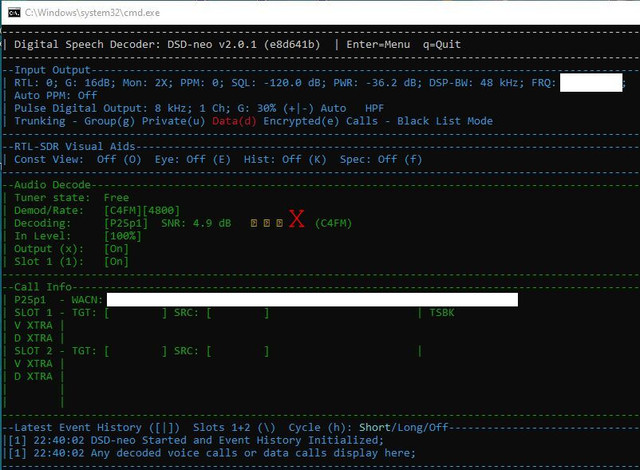
I also get bad symbols where the SNR meter should be (Se the red 'X') ?

Ah, that means the font cmd picked on your machine doesn't have wide unicode support and my check failed to detect that... you can either pick a different cmd font (Terminal/Consolas/Cascadia Mono) or invoke dsd-neo with PowerShell instead, which I think should always have wide unicode support...maybe. I'm going to push a fix to actually fallback to ASCII when this happens.
 

TheButcher

Member
Joined
Jun 12, 2013
Messages
328
Reaction score
100
"Ah, that means the font cmd picked on your machine doesn't have wide unicode support and my check failed to detect that... you can either pick a different cmd font (Terminal/Consolas/Cascadia Mono) or invoke dsd-neo with PowerShell instead, which I think should always have wide unicode support...maybe. I'm going to push a fix to actually fallback to ASCII when this happens."

I run from a batch file. So that must be cmd (as in my screen shot).

So, I can run PowerShell and launch DSD-neo ? I will try that.


"pick a different cmd font (Terminal/Consolas/Cascadia Mono)"

May you please throw a dog a bone and explain how one does this ??

I use "mode con: cols=119 lines=64" first line of my .bat file. Can one specify font in this manner may be ?

I am after a hand up and not a hand out. Appreciate your time !


"I'm going to push a fix to actually fallback to ASCII when this happens."

I am pro that decision ! It would look better to new users and old users. -Good idea ! I don't mind awaiting new future (mainstream) release.

I don't mind spending a little time in beta testing. The least I can do ;)


The networking bit. Appreciate your input there. I will have a look a little bit later and mull over what you advised (little bit technical). I am always willing to learn a bit more about networking.


For simplicity sake (in describing my set up), I have two PC 's. One with 8 SDR's (closer to my aerial) and another that I use with DSD-neo. Both PC's connected over LAN.

Also, I will check Firewall rules (Ports 7355 and 4532).


Love your work !
 

TheButcher

Member
Joined
Jun 12, 2013
Messages
328
Reaction score
100
ps. Can I use a .bat file to use PowerShell as opposed to Cmd ??? If so, how ?


I must ideally analyse some .bat files to see if this is possible.


Cheers.
 

arancormonk

Member
Joined
Dec 12, 2025
Messages
36
Reaction score
47
how can I make DSD-NEO to show the key in the consoles instead of text that says "[redacted]"
i still have to add that back as a user forced runtime argument... the intention was to stop people from accidentally sharing public screenshots or logs with keys that should not be made public, but if i make it user explicit.. then that's your problem and not mine ;)
 

arancormonk

Member
Joined
Dec 12, 2025
Messages
36
Reaction score
47
"Ah, that means the font cmd picked on your machine doesn't have wide unicode support and my check failed to detect that... you can either pick a different cmd font (Terminal/Consolas/Cascadia Mono) or invoke dsd-neo with PowerShell instead, which I think should always have wide unicode support...maybe. I'm going to push a fix to actually fallback to ASCII when this happens."

I run from a batch file. So that must be cmd (as in my screen shot).

So, I can run PowerShell and launch DSD-neo ? I will try that.


"pick a different cmd font (Terminal/Consolas/Cascadia Mono)"

May you please throw a dog a bone and explain how one does this ??

I use "mode con: cols=119 lines=64" first line of my .bat file. Can one specify font in this manner may be ?

I am after a hand up and not a hand out. Appreciate your time !


"I'm going to push a fix to actually fallback to ASCII when this happens."

I am pro that decision ! It would look better to new users and old users. -Good idea ! I don't mind awaiting new future (mainstream) release.

I don't mind spending a little time in beta testing. The least I can do ;)


The networking bit. Appreciate your input there. I will have a look a little bit later and mull over what you advised (little bit technical). I am always willing to learn a bit more about networking.


For simplicity sake (in describing my set up), I have two PC 's. One with 8 SDR's (closer to my aerial) and another that I use with DSD-neo. Both PC's connected over LAN.

Also, I will check Firewall rules (Ports 7355 and 4532).


Love your work !
Yep, if you’re launching from a `.bat`, you’re in cmd unless the batch file explicitly starts PowerShell or Windows Terminal.

You can absolutely launch DSD-neo via PowerShell from a batch file. Something like this should work:

powershell -NoLogo -NoExit -Command "& 'C:\path\to\dsd-neo.exe' [your usual args here]"

If you have PowerShell 7 installed, the command may be `pwsh` instead of `powershell`.

One small gotcha: if PowerShell is launched inside the same old cmd window, it may inherit the same console/font weirdness. So if the Unicode display still looks broken, try opening PowerShell directly from the Start menu or Windows Terminal, then run the same DSD-neo command there.

For the font: `mode con: cols=119 lines=64` can change the window size, but not the font. Fonts are set through the console window settings.

In classic cmd:
- right-click the title bar
- choose `Properties` or `Defaults`
- go to the `Font` tab
- pick something like `Consolas`, `Cascadia Mono`, or `Terminal`
- hit OK

`Properties` usually affects that shortcut/session. `Defaults` affects new console windows more broadly.

If you’re using Windows Terminal:
- open Settings
- pick your Command Prompt or PowerShell profile
- Appearance
- Font face
- choose `Cascadia Mono` or similar
 

MELERIX

Member
Joined
Nov 19, 2018
Messages
90
Reaction score
57
using DSD-NEO in TCP mode, it works fine, but I'm getting "WARNING: Input Level LOW -120.0 dBFS: raise source/input volume" each few seconds when there is no signal, is there a way to fix it?
 
Top